
Your Statement of Purpose (SOP) is often the only part of your application where an admissions or scholarship committee actually hears your voice. Transcripts show your grades. Recommendation letters show what others think of you. The SOP is where you explain, in your own words, why you deserve a seat in the program — or a place among a scholarship’s fellows.
That’s exactly why it deserves more than a quick spell-check before you hit submit.
Why an SOP Needs a Different Kind of Review
Grammar tools like Grammarly are good at catching typos and awkward phrasing, but they weren’t built to judge whether your opening paragraph actually grabs a reader, whether your narrative has a clear thread from past to future, or whether a scholarship panel would find your motivation convincing. That kind of feedback usually meant paying a consultant or waiting for a mentor to find time to read your draft.
An AI-powered SOP reviewer closes that gap. It reads your statement the way an admissions reader would — checking structure, tone, persuasiveness, and clarity — and gives you feedback in seconds instead of days.
What a Good SOP Reviewer Actually Checks
A useful SOP review tool should go well beyond word count. At minimum, look for feedback on:
- Structure — does your SOP follow a logical past → present → future arc, or does it wander?
- Opening and closing strength — the first and last lines are what reviewers remember most.
- Academic and professional tone — informal or overly emotional language can weaken an otherwise strong story.
- Persuasiveness — are your claims backed by specific examples, or are they generic statements anyone could write?
- Grammar and clarity — sentence-level issues that distract from your message.
- Personal narrative strength — does the essay actually sound like you, or like a template?
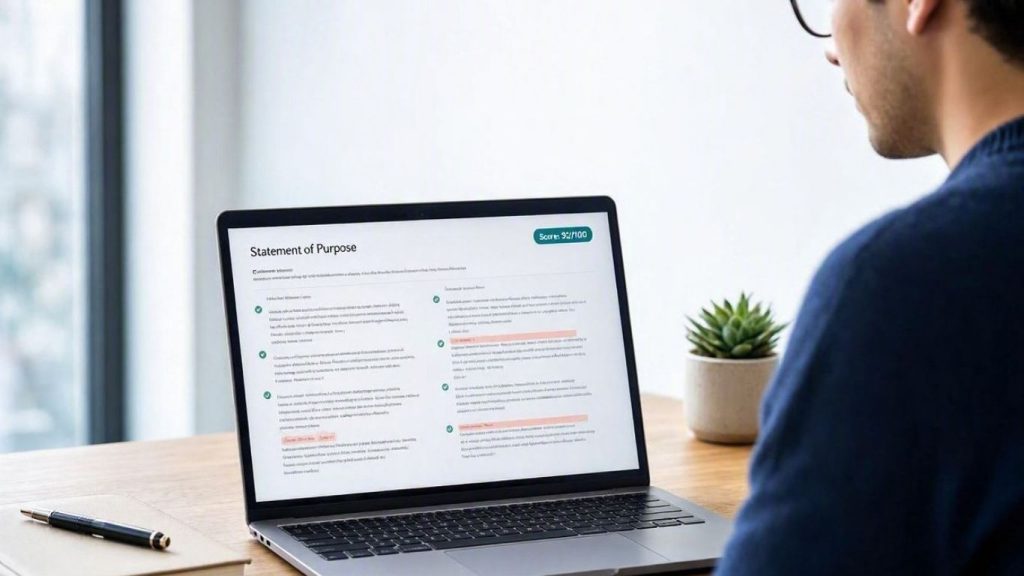
SR Publishers’ free SOP Reviewer checks all of these. You paste your draft (it works best with 200–1,500 words), and the tool scores it across these dimensions, highlights individual sentences as strong, weak, or in need of fixing, and gives you rewrite suggestions you can act on immediately. It’s free, requires no sign-up, and works for Statements of Purpose, motivation letters, personal statements, and scholarship essays for programs like Chevening, Fulbright, and Commonwealth.

Step-by-Step: How to Review Your SOP Before You Submit
- Write a complete first draft. Don’t try to perfect sentences as you go — get the full story down first, from your background to your goals.
- Run it through an SOP reviewer. Paste your draft into the SOP Reviewer and read the sentence-by-sentence analysis carefully. Note which sentences are flagged as weak or unclear.
- Fix the structural issues first. If the tool flags a weak opening or a disconnected narrative, rewrite that before polishing individual words.
- Address the sentence-level suggestions. Work through the rewrite suggestions one by one — you don’t have to accept every one, but each is worth considering.
- Re-run the check. After editing, paste the revised version back in and compare your new score against the old one.
- Get a human read. Once your AI-assisted draft is strong, share it with a mentor, professor, or someone who has been through the same application process. Treat the AI review as your first-pass filter, not your final judge.
A Note on Originality
A polished SOP is only useful if it’s genuinely yours. Reusing lines from sample essays you found online, or leaning too heavily on AI to generate entire paragraphs, creates real risk — many scholarship committees and universities now screen submissions for both plagiarism and AI-generated text. Before you submit, it’s worth running your SOP through a plagiarism checker as well, especially if you used any online SOP samples for inspiration.
Who Should Use an SOP Reviewer
This kind of tool is useful at almost every stage of the application process — for undergraduate personal statements, master’s and PhD SOPs, and scholarship essays for programs such as Chevening, Fulbright, Commonwealth, and DAAD. Chevening’s own application guidance tells applicants to check their grammar, make sure sentences make sense, and use relevant examples from their own experience — exactly the kind of feedback a good AI reviewer surfaces automatically.
If you’re still building your academic story before you get to the writing stage, it also helps to have your target programs and timeline sorted first. See our guides on how to write a PhD research proposal, best countries for fully funded PhD scholarships, and the study abroad timeline checklist to plan your application around real deadlines.
Final Thought
An SOP reviewer won’t write your story for you — and it shouldn’t. What it does is show you, sentence by sentence, where your story is landing and where it’s losing the reader, so you can fix it before a real admissions committee ever sees it. Used as a first-pass filter rather than a final authority, it’s one of the fastest ways to turn a rough draft into a submission-ready statement.