

Applying for an international scholarship like in USA, UK, Canada or Austrailia can change the trajectory of your academic and professional life. While academic transcripts and test scores prove your eligibility, your motivation letter is the single most critical document that convinces selection committees that you deserve their financial backing.
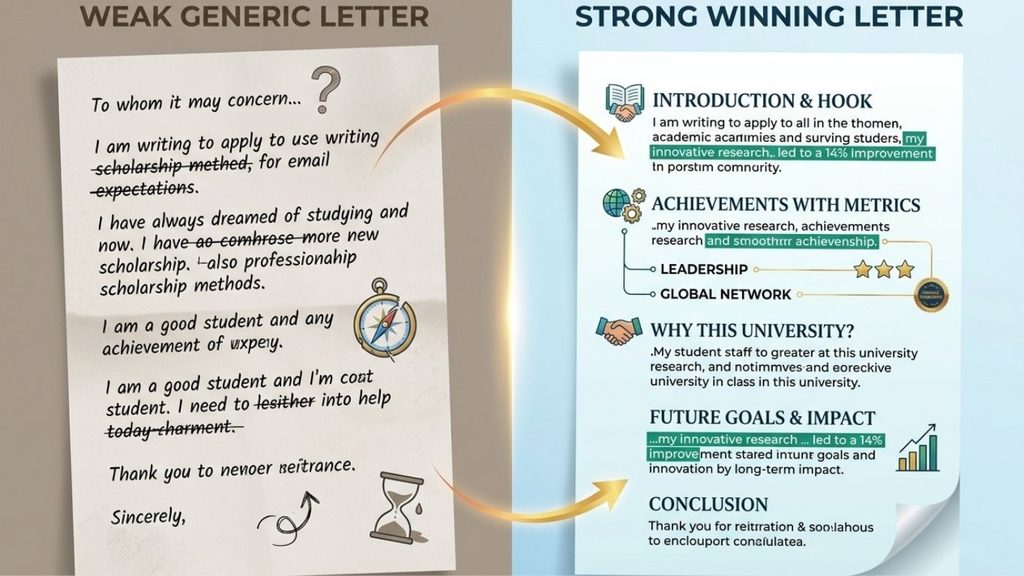
Whether you are applying for prestigious global fully funded programs like Chevening, Erasmus Mundus, DAAD, or university-specific merit grants, this guide covers everything you need to construct a compelling, professional, and winning motivation letter.
1. Introduction: What is a Motivation Letter?
A motivation letter (sometimes referred to as a letter of motivation) is a tailored formal essay addressed to a university admissions board or scholarship committee. Its core objective is to explain why you are applying, why you are the ideal candidate, and how receiving the scholarship aligns with your future ambitions.
Motivation Letter vs. Personal Statement vs. Statement of Purpose (SOP)
Applicants often mix up these terms, which can weaken an otherwise strong application. Here’s the key difference:
- Motivation Letter: Focuses heavily on the future — your drive, why you chose this specific scholarship/university, and how the financial grant will enable your goals.
- Personal Statement: Focuses on your past personal narrative, challenges overcome, personal growth, and individual identity.
- Statement of Purpose (SOP): Focuses on your academic history, research background, specific course modules, and technical/academic readiness for a degree program.
Note: Some universities use these terms interchangeably in their application instructions — always check the exact document the scholarship provider is asking for before you start writing.
2. Structure & Formatting Guidelines
Selection committees read hundreds, sometimes thousands, of letters. A clean, well-organized letter makes it easier for reviewers to quickly find the information they’re looking for — and many scholarship platforms now also run submissions through plagiarism- and AI-content-detection tools alongside human review, so originality matters as much as structure.
Key Formatting Guidelines
- Length: 400 to 700 words (usually 1 page). Never exceed 2 pages unless explicitly instructed.
- Font & Size: Arial, Times New Roman, or Calibri in 11pt or 12pt font.
- Margins & Spacing: Standard 1-inch margins with 1.15 line spacing.
- Tone: Formal, professional, confident, yet humble. Avoid overly conversational language or academic jargon.
(Always double-check the specific scholarship’s guidelines first — some programs specify their own word limits, fonts, or formats.)
3. Step-by-Step Breakdown: What to Write in Each Paragraph
Using the proven Past → Present → Future framework ensures a seamless flow of thoughts:
[Salutation]
       │
[Header & Introduction] ──► Hook + Degree/Scholarship Name + Direct Goal
    How to Write a PhD Research Proposal (Step-by-Step Guide)   │
[Academic & Professional Background] ──► Showcasing Achievements with Metrics
       │
[Alignment & Need] ──► Why This Specific University & Scholarship?
       │
[Future Impact] ──► Long-Term Goals + Value Back to Community/Industry
       │
[Conclusion & Call to Action]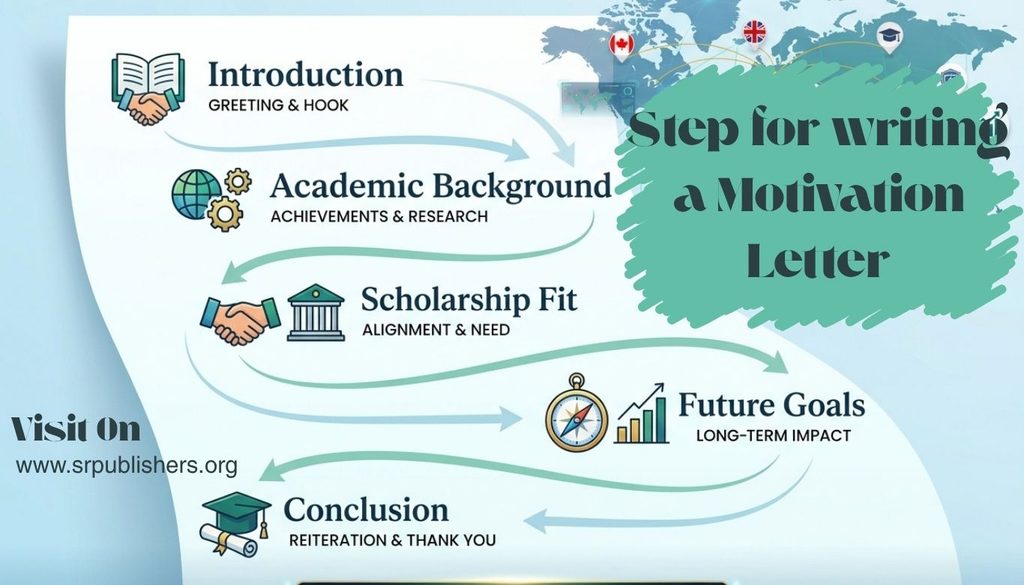
Paragraph 1: The Hook & Introduction
Avoid boring clichés like “I am writing to express my interest…” or “I have always dreamed of studying abroad.” State directly who you are, the degree and scholarship program you are targeting, and a strong core statement highlighting your academic focus.
Paragraph 2: Academic & Professional Background (Past to Present)
Highlight relevant academic accomplishments, key thesis work, or industry experience.
- Pro Tip (Show, Don’t Tell): Instead of writing “I am a dedicated student with leadership skills,” write “While maintaining a 3.8 GPA, I led a team of 4 researchers on a renewable energy initiative that won the regional innovation award.”
Paragraph 3: Why This Specific University and Scholarship?
Demonstrate thorough research about the university. Mention specific professors, lab facilities, course modules, or institutional values. Explain how the scholarship addresses your practical financial needs without coming across as overly dramatic.
Paragraph 4: Long-Term Goals & Impact (Future)
Scholarship panels consider awards an investment. Outline your 5-year plan and explain how receiving this scholarship will allow you to address real-world problems in your home country or industry.
Paragraph 5: Conclusion
Reiterate your suitability, express appreciation for their consideration, and provide a polite closing statement.
4. Motivation Letter Examples for Scholarships
Example 1: STEM & Research-Focused Scholarship (e.g., DAAD / Master’s in Data Science)
Dear Selection Committee, As a Computer Science graduate specializing in machine learning algorithms, I am applying for the [Scholarship Name] to pursue a Master’s Degree in Data Science at [University Name]. My long-term goal is to design scalable AI models that optimize agricultural supply chains in developing nations. During my undergraduate studies at [Previous University], I focused on agricultural yield predictions using computer vision. My final-year research project led to a 14% improvement in crop disease detection efficiency, receiving first prize at the National Tech Symposium. Additionally, my internship at [Company Name] allowed me to process real-time geospatial datasets, cementing my technical foundation in Python, PyTorch, and cloud infrastructure. [University Name]’s Master in Data Science program offers specialized coursework in Predictive Analytics and Sustainable Tech Systems, led by Dr. [Professor’s Name]. The opportunity to access the Advanced AI Laboratory perfectly complements my goal to build predictive tools for farmers facing climate uncertainty. Securing the [Scholarship Name] is essential for funding my advanced studies without financial strain. Upon completion of my degree, I plan to return to my home region to partner with local agricultural cooperatives, leveraging AI to reduce post-harvest losses. Thank you for considering my application. I look forward to the opportunity to contribute to your academic community. Sincerely, [Your Name]
Example 2: Leadership & Social Impact Scholarship (e.g., Chevening / Erasmus Mundus)
Dear Members of the Scholarship Committee, I am writing to express my strong candidacy for the [Scholarship Name] to enroll in the Master of Public Policy program at [University Name]. With three years of experience coordinating community literacy projects in underserved areas, my mission is to advocate for equitable educational policies. Currently serving as Project Coordinator at [NGO Name], I spearheaded an initiative that provided digital learning tools to over 2,500 rural students, achieving a 30% increase in secondary school completion rates. This experience revealed how systemic funding barriers limit potential, driving my interest in sustainable policy design. I chose [University Name] due to its interdisciplinary curriculum in Education Economics and its active involvement in international development projects. The university’s emphasis on empirical research aligns directly with my intention to design evidence-based educational reform policies. The financial support from [Scholarship Name] will allow me to engage fully in academic coursework and extracurricular leadership forums without financial hardship. Upon graduation, I intend to collaborate with non-profit organizations and governmental bodies to implement sustainable educational models. I appreciate your time and consideration of my application. Sincerely, [Your Name]
5. What Else Do You Need for a Complete Scholarship Application?
A motivation letter is a vital piece of the puzzle, but it is only one component of a complete application package. To secure approval from international universities, you must submit a well-coordinated set of documents.
📌 Related Read: For the complete list of required documents, check out our full guide on what documents you need for a successful scholarship application —
Also check that How to Write a PhD Research Proposal (Step-by-Step Guide)
Most global scholarships require:
- Academic Transcripts & Certificates: Officially verified copies.
- Letters of Recommendation (LORs): 2–3 references from academic professors or workplace supervisors.
- Updated Academic CV / Resume: Formatted according to Europass or international standards.
- Proof of Language Proficiency: IELTS, TOEFL, or official English Proficiency Certificates (check first — some scholarships waive this requirement).
- Research Proposal: Required primarily for Master’s by Research and Ph.D. applications.
6. Action Verbs & Vocabulary Cheat Sheet
Replace weak verbs with high-impact, actionable language:
| Weak Phrase | Strong Action Verb / Alternative |
|---|---|
| “I was in charge of a project” | “Spearheaded” / “Orchestrated” |
| “I worked hard to improve results” | “Optimized” / “Elevated” |
| “I made a new system” | “Formulated” / “Pioneered” |
| “I want to solve this issue” | “Mitigate” / “Address systemic challenges” |
7. Common Mistakes to Avoid
- Using Generic Templates Without Customization: Selection committees instantly recognize copy-pasted letters where only the university name has been swapped.
- Overusing Unfiltered AI Tools: Generative AI tools can help with structuring and brainstorming, but submitting raw AI-generated text often results in generic language that AI-detection tools and human reviewers can easily spot.
- Focusing Exclusively on Sympathy: Avoid relying solely on hardship stories. Frame challenges positively by highlighting resilience and achievements.
- Ignoring Word Count Limits: Exceeding stated limits demonstrates an inability to follow instructions.
8. Final Pre-Submission Checklist
- Tailored Content: Does the letter explicitly state why this university and this scholarship fit your goals?
- Quantifiable Results: Have you included concrete metrics (e.g., percentages, team sizes, project outcomes)?
- Formatting Check: Is it set to standard fonts, clear spacing, and a clean single-page format?
- Proofreading: Has it been checked for spelling, grammatical accuracy, and clarity?
- Tone Check: Does it maintain a professional, confident tone without coming across as entitled?
9. Frequently Asked Questions (FAQs)
Can I use AI tools like ChatGPT to write my motivation letter?
You can use AI tools for outlining, proofreading, or improving sentence structure. However, writing the entire letter using AI often leads to generic content, overused clichés, and potential rejection by AI-detection filters. Make sure the final voice and personal details are entirely your own.
Is it mandatory to submit a different motivation letter for every scholarship?
Can I use AI tools like ChatGPT to write my motivation letter?
You can use AI tools for outlining, proofreading, or improving sentence structure. However, writing the entire letter using AI often leads to generic content, overused clichés, and potential rejection by AI-detection filters. Make sure the final voice and personal details are entirely your own.
What should I focus on if I have a lower GPA?
Shift the focus toward practical achievements, leadership roles, impactful research projects, internships, and clear long-term career goals. Explain briefly how you overcame academic hurdles without lingering on excuses.