
If you’ve ever talked to a student who missed a scholarship deadline by three days, or one whose visa appointment landed two weeks after their flight was already booked, you know that studying abroad rarely goes wrong because of grades. It goes wrong because of timing. Here’s a realistic, month-by-month study abroad timeline for the 2027 intake — what to do, roughly when, and where things usually fall apart.
What Is the Study Abroad Timeline for the 2027 Intake?
For a Fall/September 2027 intake, most students should start planning around 15–18 months out — roughly by early-to-mid 2026. That gives you room for English proficiency and admissions tests, university shortlisting, applications, scholarship deadlines (which often land earlier than the university’s own), and the visa process, which can take anywhere from a few weeks to a few months depending on the destination.
Why Timing Trips Up More Students Than Grades Do
Universities rarely reject strong students because their grades were weak. They reject applications that are incomplete, late, or missing a document that took longer to arrange than expected — a translated transcript can take three weeks, a recommendation letter from a professor on sabbatical even longer, and scholarship committees, unlike universities, don’t usually send reminder emails.
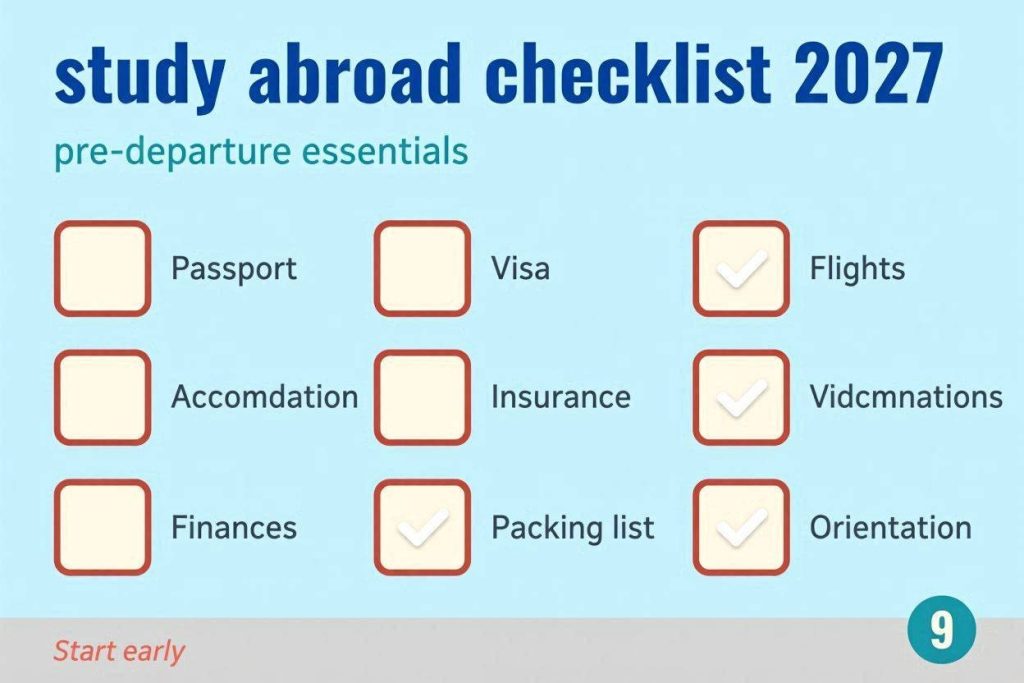
The students who plan 15+ months out aren’t necessarily more organized by nature — they’ve just built in slack. When an IELTS score comes back lower than hoped, they have time for a retake. When a professor takes three weeks to reply, it doesn’t derail the whole application.
That said, the pace differs by destination. A UK application through UCAS moves differently from a US Fall cycle on the Common App, and Germany — thanks to document verification requirements for many applicant pools — runs longer than almost anywhere else. Treat the timeline below as a framework and adjust it against your specific target countries.
Month-by-Month Study Abroad Timeline at a Glance
| Months Before Intake | Focus |
|---|---|
| 18–15 | Country/course research, budget, shortlisting universities |
| 14–11 | IELTS/TOEFL, GRE/GMAT if required, narrowing your list |
| 10–8 | Transcripts, SOP drafts, requesting recommendation letters |
| 8–6 | Applications via UCAS, Common App, or direct university portals |
| 7–5 | Scholarship deadlines — often earlier than university ones |
| 5–3 | Offers, interviews, deposits |
| 4–2 | Visa documents, appointments, financial proof |
| 2–0 | Insurance, housing, flights, orientation |
This table is a planning aid, not a guarantee — deadlines are set individually by each university and immigration authority. Always confirm on the official page for your specific program.
Phase 1: Research and Foundation (15–18 Months Out)
This stage feels slow, and students often rush through it — which is a mistake, since decisions made here (country, program type, budget) shape everything downstream.
- Narrow your target countries by program strength in your field, total cost (tuition plus living expenses — Germany can cost a fraction of a comparable US program), and post-study work options, which change often enough to verify rather than assume.
- Build a list of 15–20 universities across reach, match, and safety — you’ll cut it roughly in half once you know your scores and budget.
- Confirm which intake each program actually offers; not every university runs multiple cycles.
- Start collecting academic records now — a certified translation or apostille can take longer than expected once you’re waiting on a school’s admin office.
On intake terms: Fall intake (Aug–Sept) is the main cycle for the US, UK, and Canada. Spring intake (Jan–Feb) exists at some US/Canadian schools with fewer options. September intake is essentially the UK’s main cycle. January intake is a smaller secondary option at some universities — useful if you’re starting late, but with fewer programs and less funding available.
Phase 2: Testing Window (11–14 Months Out)
- IELTS/TOEFL: Required by nearly every destination, though the minimum score varies by university and program — check the specific admissions page rather than assuming a country-wide number. Four to eight weeks of prep is typical.
- GRE/GMAT: Required for many Master’s and MBA programs, though increasingly optional at others — verify per program. If needed, budget three to five months of prep, not a six-week crash course.
- Leave room for a retake. “I wish I’d taken it a month earlier” is the most common regret students report after the fact, and score reports take time to reach universities too.
Phase 3: Documents, Essays, and Recommendations (8–10 Months Out)
- SOP: Write more than one draft. The ones that work connect a specific reason for the program to a specific next step — not “passion for the field,” which reads as filler. Also check best guide on: How to write an SOP.
- Recommendation letters: Ask at least six weeks before your earliest deadline (often a scholarship or Early Decision date, not the general one). Give recommenders your CV and a reminder of the work you did together — a rushed request usually produces a generic letter.(check how to write best international CV by clicking this link: how to write international standard CV
- Transcripts: Start translation or apostille steps as soon as your shortlist is set, since these involve third parties on their own timeline.
Phase 4: Applications (6–8 Months Out)
- US: Common App, opening around August 1, with Early Decision/Action around November 1 and Regular Decision in the January 1–15 range — exact dates vary by school.
- UK: UCAS. Oxbridge and Medicine/Dentistry/Vet Science have a mid-October deadline; most other universities close January 31. Verify both directly on UCAS.
- Canada and Australia: Mostly direct-to-university, with deadlines far more spread out — some rolling, particularly in Australia.
- Germany: Through Uni-Assist or directly to the university. If your country requires academic document verification (like India’s APS process), that needs to be underway 9–12 months before your semester — well before the application deadline itself.
Submit a few days early where you can. A portal glitch at 11:58 PM isn’t a deadline extension.

Scholarship Timeline: Don’t Leave It for Later
Many merit-based and country-specific scholarships have separate deadlines that land earlier than the university’s own — sometimes by months.
- 8–10 months out: Research destination- and field-specific scholarships (university merit awards, government programs like Chevening or DAAD scholarships, diaspora awards).
- 7–9 months out: Draft scholarship essays separately from your SOP — they often ask different questions (financial need, leadership) and reusing your SOP wholesale reads as lazy.
- 6–8 months out: Submit, tracking each deadline independently on your spreadsheet.
- 3–5 months out: Decisions typically arrive here, sometimes before or after your admission decision — plan your visa financial documentation with that uncertainty in mind.
Phase 5: Offers and Financial Planning (3–5 Months Out)
- Compare offers on total cost, scholarship value, and program reputation in your specific field — not just overall university ranking.
- Practice for interviews where required (some MBA programs, some UK universities, occasionally Oxbridge) — aim for comfort explaining your choices, not memorized answers.
- Financial documentation takes longer than expected. Requirements like the UK’s continuous-holding-period rule or Germany’s blocked-account structure do get updated, so confirm the current figure on the official page rather than trusting last year’s number.
Phase 6: Visa Application (2–4 Months Out)
This is the stage you control the least, so start it the moment you accept your offer.
- Processing times vary by country and change periodically — treat any number you read, including here, as a starting estimate and confirm current timelines on the relevant government site.
- Canada discontinued its fast-track Student Direct Stream in late 2024; all applicants now go through the standard, generally slower study permit process. Check IRCC directly.
- Australia replaced the old Genuine Temporary Entrant statement with the Genuine Student requirement in 2024 — a set of targeted questions, not a single personal essay. Read the current format on Australia’s official guidance.
- Germany requires academic document verification before the visa stage for many applicant pools — this alone can take weeks to a couple of months.
- USA requires an in-person F-1 interview; book as early as your I-20 allows, since slot availability varies by consulate and season.
Phase 7: Pre-Departure (0–2 Months Out)
- Arrange health insurance, mandatory in some countries and optional in others.
- Apply for housing early — many universities allocate it first-come, first-served.
- Book flights only after visa approval; a visa delay turning into a change fee is common and avoidable.
- Attend your university’s pre-departure orientation for concrete, campus-specific answers.
Printable Checklist
- [ ] Shortlisted 15–20 universities (reach/match/safety) and confirmed actual intake months
- [ ] Registered for IELTS/TOEFL and GRE/GMAT (if required), with retake room in the calendar
- [ ] Requested transcripts and started translation/apostille if needed
- [ ] Drafted SOP (2+ revisions) and asked recommenders six weeks ahead
- [ ] Tracked every deadline — university and scholarship — on one spreadsheet
- [ ] Researched and applied to scholarships on their own timeline
- [ ] Gathered proof-of-funds in the exact format required
- [ ] Confirmed current visa processing times officially, then booked the appointment
- [ ] Arranged insurance, housing, and flights (in that order) before departure
Country-Specific Notes
Deadlines and visa rules are set independently by each country and do change — verify everything below on the official source before acting on it.
United States — Common App, Early Decision/Action around November 1, Regular Decision in January. F-1 visa needs an in-person interview. EducationUSA is the official government resource.
United Kingdom — UCAS, with an earlier Oxbridge/Medicine deadline and a later general one. Check current financial evidence rules on gov.uk directly.
Canada — Direct-to-university applications; study permits now run through the standard stream after SDS ended in 2024. Confirm timelines on IRCC’s site.
Australia — More flexible intake timing (February and July cycles at many schools). Visa applicants now answer the 2024 Genuine Student questions rather than a GTE statement.
Germany — Largely tuition-free public education, but a longer runway due to document verification. Start 9–12 months out. DAAD is the official resource for programs and scholarships.
Ireland — English-speaking, EU-adjacent, with a generous post-study work visa. Some programs apply through the CAO, others direct — confirm which applies to yours.
New Zealand — Smaller application pool (less competition, but also fewer scholarships). Confirm intake timing directly with your institution, since its calendar doesn’t always mirror the northern hemisphere.

Common Mistakes Students Actually Make
- Writing the SOP in one sitting. The applications that stand out went through at least three drafts and a second pair of eyes.
- Assuming scholarship and university deadlines match. They often don’t, and by the time it’s noticed, the scholarship window has closed.
- Booking flights before visa approval. Feels efficient, usually isn’t once a change fee shows up.
- Underestimating Germany’s timeline because tuition-free sounds simple — the document verification step alone can eat several months.
- Trusting last year’s visa rules. Financial thresholds, document formats, and even entire visa streams (like Canada’s SDS) change. Check the official page before submitting anything.
Suggested Further Reading
Worth covering separately: structuring an SOP that avoids generic phrasing, what makes a recommendation letter effective, a realistic IELTS/TOEFL prep plan, writing a motivation letter for Germany or Europe, student visa financial requirements by country, and a broader guide to choosing between study destinations.
Frequently Asked Questions
I have six months before my intended intake — is Fall 2027 still realistic? Depends on the destination. Workable for some rolling-admission programs (Australia), tight for the US or UK’s main cycles, likely too short for Germany. Spring or January intake the following cycle may fit better.
Do I need both an English test and GRE/GMAT? Not always. English proficiency is required almost everywhere; GRE/GMAT is increasingly optional at many programs. Check each university’s admissions page rather than assuming a blanket rule.
What’s the real difference between Fall, Spring, and January intake? Fall (Aug–Sept) is the primary cycle for the US, UK, and Canada, with the widest range of programs and funding. Spring (Jan–Feb) exists at some US/Canadian schools with fewer options. “January intake” is sometimes used interchangeably with Spring depending on the university — check the specific term used by your program.
How much earlier should I apply for scholarships versus the university itself? Anywhere from a few weeks to a few months earlier, depending on the scholarship. Start researching scholarship-specific timelines as soon as your shortlist is final.
Is the visa process the same across these countries? No. Each country sets its own documentation, financial evidence, and processing standards, and these change periodically — Canada’s 2024 SDS closure and Australia’s 2024 Genuine Student update are recent examples. Never assume one country’s rules apply to another.
What if I miss my target intake entirely? Not a dead end. Most universities run another intake, or you can target the following year’s cycle with stronger test scores, a sharper application, and more scholarship options — often a better outcome than rushing an underprepared one in.
Every deadline here is a planning reference, not a fixed rule — universities and immigration authorities revise their own requirements independently. The most useful habit isn’t memorizing dates from an article like this one; it’s checking the official source for your specific university and country before every major step.