
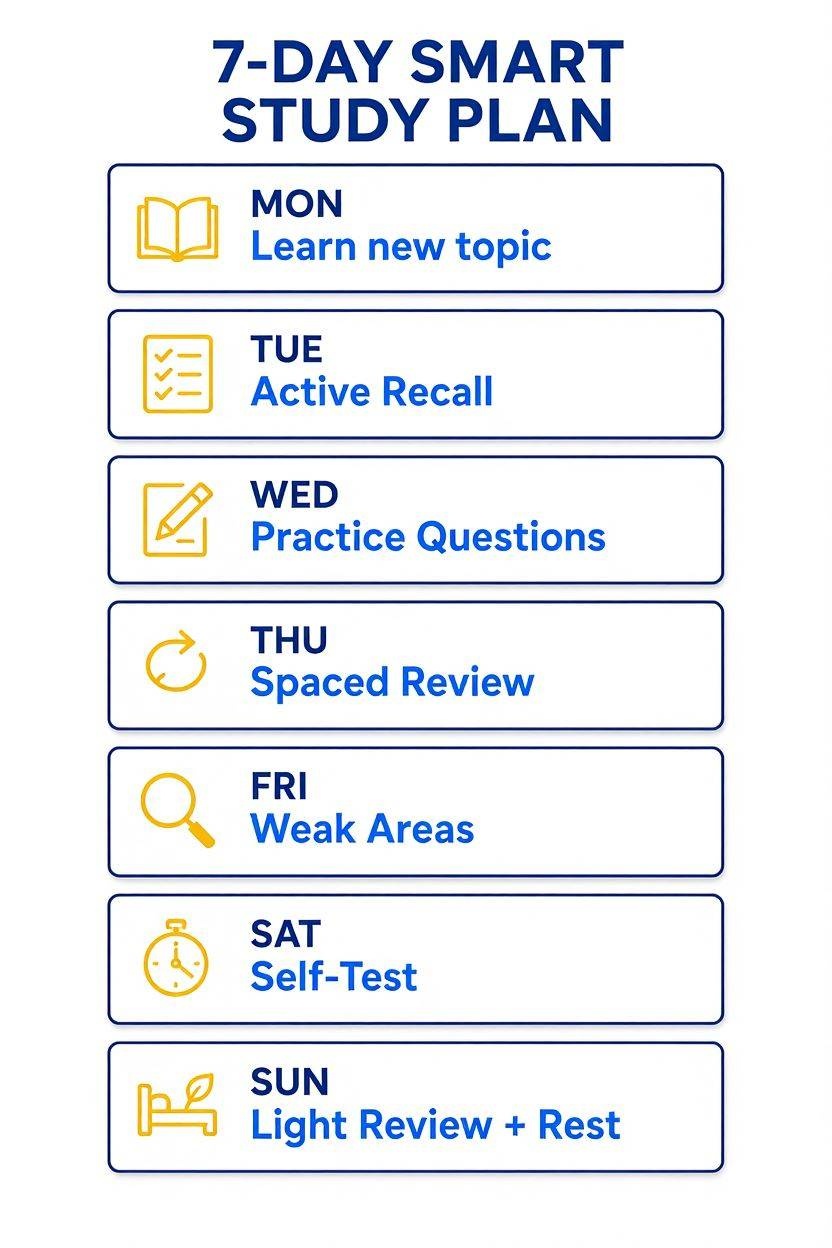
You’ve probably spent hours highlighting a textbook, closed it feeling accomplished, and then failed the test on that exact material a week later. That gap — between how productive studying feels and how much you actually remember — isn’t bad luck, and it isn’t a sign you’re bad at studying. It’s a well-documented trick of the mind. Decades of research in cognitive and motivational psychology have identified exactly why this happens, and exactly what to do instead. This article walks through that evidence, principle by principle, and turns it into a study plan you can actually follow.
Why Most Study Plans Fail Before They Start
Here’s the trick: the instinct to reread and highlight isn’t laziness. It’s a cognitive illusion called the fluency illusion. When information feels familiar because you’ve just looked at it, your brain mistakes that familiarity for understanding.
Want to know about study plans check this out: Study Abroad Timeline: Month-by-Month Checklist for 2027 Intake
Check this out also How to Write a PhD Research Proposal (Step-by-Step Guide)
Think of it like driving a route you’ve ridden as a passenger a hundred times. Watching the road go by feels like you’d know every turn — until you’re behind the wheel yourself and realize you never actually learned the way. Rereading is watching from the passenger seat. Recalling from memory is driving.

Research comparing common study techniques found that the strategies students rely on most — highlighting, rereading, and summarizing — consistently produce weak, short-lived learning, while two far less popular techniques, self-testing and spacing, show the strongest and most consistent effects on retention.
A good study plan, then, isn’t really a scheduling problem. It’s a psychology problem: it has to work with how memory is formed, with how motivation actually behaves under deadline pressure, and with the fact that willpower is not a reliable resource to build a plan on top of.
Principle 1: Build the Plan Around Retrieval, Not Review
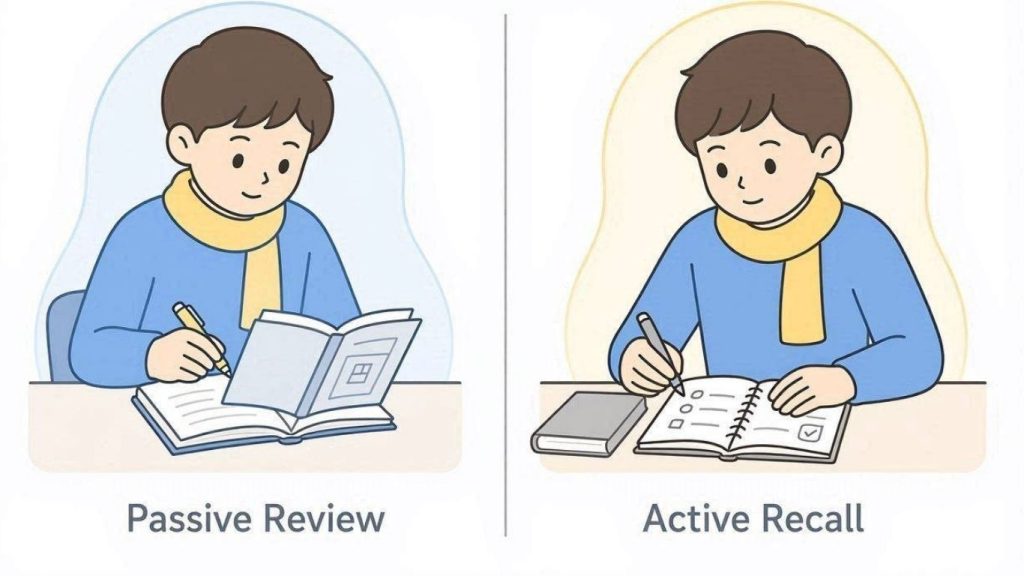
The single most well-supported finding in learning science is this: the act of pulling information out of your memory strengthens it far more than putting information into your memory does. This is called retrieval practice or active recall.
Think of memory like a path through a forest. Rereading is standing at the edge, looking at the path. Retrieval is actually walking it — and every time you walk it, the path gets clearer and easier to find again. Closing the book and trying to reconstruct what you just read — from memory, in your own words, without peeking — does more for retention in ten minutes than thirty minutes of rereading.
What this looks like in a real plan:
- Every study session ends with a closed-book self-test, not a reread.
- Flashcards are used to answer, not to review — if you flip the card without trying to answer first, you’ve lost most of the benefit.
- Practice questions, past papers, and “explain this concept to someone who’s never heard of it” exercises replace passive note-review as the default activity.
Principle 2: Space It Out — Cramming Is a Trap That Feels Like Progress
The second research-backed pillar is spacing: studying the same material in short sessions spread across days and weeks, rather than in one long block. Spaced practice consistently outperforms massed practice (cramming) for long-term retention, even though cramming feels more efficient in the moment because the material feels fresher right after a marathon session.

It’s the same reason watering a plant once a month with a flood does far less good than watering it a little every few days. A single soaking overwhelms the roots and drains away; steady, spaced watering is what the roots actually absorb and grow from. Memory works the same way — a single all-night session floods in and drains out, while spaced review is what actually takes root.
A practical spacing rhythm for exam prep:
| Time before exam | What to review |
|---|---|
| Day you learn it | Same-day 10-minute self-test |
| +2 days | Retest without notes |
| +1 week | Retest, focus only on what you got wrong |
| +2–3 weeks | Final retest, mixed with other topics |
This is also why a study plan built the night before a test is structurally doomed — spacing needs a runway of weeks, not hours.
Principle 3: Set Goals the Way Goal-Setting Theory Says To
Edwin Locke and Gary Latham’s goal-setting theory, built from decades of research, found that specific, moderately difficult goals consistently produce better performance than vague goals like “study more” — and that this holds true whether the goal covers one minute or 25 years.
A vague goal is like telling a taxi driver “take me somewhere nice” — there’s no destination to aim for, so there’s no way to know when you’ve arrived, or whether you’re even headed the right way. A specific goal is giving an exact address. “Study biology for two hours” is the vague version. “Answer 20 past-paper questions on cellular respiration and correct every wrong one” is the exact address — and it’s the kind the research says actually works.
When translating this into a plan:
- Replace time-based goals (“study for 2 hours”) with output-based goals (“complete 3 practice sets, self-test on 2 chapters”).
- Keep goals difficult enough to require real effort, but not so large they feel impossible — moderate, specific difficulty is the sweet spot the research identifies.
Principle 4: Close the Intention-Action Gap with Implementation Intentions
Setting a goal is not the same as acting on it. This gap between intending to study and actually opening the book is one of the best-documented failure points in student behavior, closely tied to procrastination and temporal discounting (the tendency to weight immediate comfort over distant rewards like exam results).
It’s the difference between having a destination in your GPS and actually having turn-by-turn directions. Knowing where you want to end up doesn’t move the car — you need the next turn spelled out. Psychologist Peter Gollwitzer’s research on implementation intentions — simple “if-then” plans — has repeatedly been shown to close this gap. Instead of a vague intention (“I’ll study more this week”), an implementation intention names the exact trigger and the exact action: “If it is 6 PM after dinner, then I open my chemistry notes at the kitchen table.” Later work combining this with mental contrasting (vividly imagining the goal and the obstacle in the way of it) has shown even stronger effects on follow-through, including in reducing procrastination-driven delay.
A study plan should therefore specify:
- The exact cue (time, place, or preceding action) — not just “sometime today.”
- The exact first action — the smallest possible starting step, since starting is where most intentions die.
Principle 5: Protect Self-Efficacy — Confidence Is Not a Personality Trait, It’s Built
Albert Bandura’s research on self-efficacy — a person’s belief in their own ability to succeed at a specific task — found that this belief is one of the strongest predictors of whether someone follows through on a goal at all.

Self-efficacy works like a muscle, not a talent you either have or don’t. Nobody walks into a gym and lifts their heaviest weight on day one — confidence is built with smaller, manageable weights that gradually prove what the body can do. Self-efficacy isn’t fixed; it’s built through small, visible wins. This is why a study plan should be front-loaded with achievable early tasks: not because the material is easy, but because early success is what fuels the motivation to keep going through the harder material later.
Putting It Together: A One-Week Sample Plan
| Day | Focus | Method |
|---|---|---|
| Mon | New topic, Chapter 1 | Read once, then closed-book recall summary |
| Tue | Chapter 1 retrieval + new Chapter 2 | Self-test Ch.1, first pass on Ch.2 |
| Wed | Chapter 2 retrieval | Self-test, correct errors only |
| Thu | Mixed retrieval, Ch.1 + Ch.2 | Interleaved practice questions |
| Fri | New topic, Chapter 3 | Read once, closed-book recall |
| Sat | Full-week spaced retest | Mixed practice set, all 3 chapters |
| Sun | Rest / light review | Skim only errors from Saturday’s test |
Notice what’s absent: hours of highlighting, rewriting notes, or rereading slides. Every single block is either new encoding or retrieval — because that’s what the evidence says actually builds durable memory.
Quick Checklist: Is Your Study Plan Actually Evidence-Based?
- [ ] Every session ends with a closed-book self-test, not a reread
- [ ] Flashcards are answered first, then flipped — not flipped first
- [ ] The same material gets reviewed again in 2 days, 1 week, and 2–3 weeks — not all at once
- [ ] Goals are specific and output-based (“3 practice sets, 2 chapters self-tested”), not vague (“study for 2 hours”)
- [ ] Each task has an exact if-then trigger (“If it’s 6 PM after dinner, then…”) instead of “sometime today”
- [ ] The first task on the plan is small enough to guarantee an early win
- [ ] Cramming the night before is not the plan — spacing has a runway of weeks
The Real Takeaway
An effective study plan isn’t a prettier calendar, and it isn’t about finding more hours in the day. It’s a set of specific retrieval-based tasks, spaced across time, attached to exact triggers, sized to build early confidence. Psychology doesn’t ask students to study harder — it asks them to study differently. Follow the checklist above, and the plan does the remembering for you.