
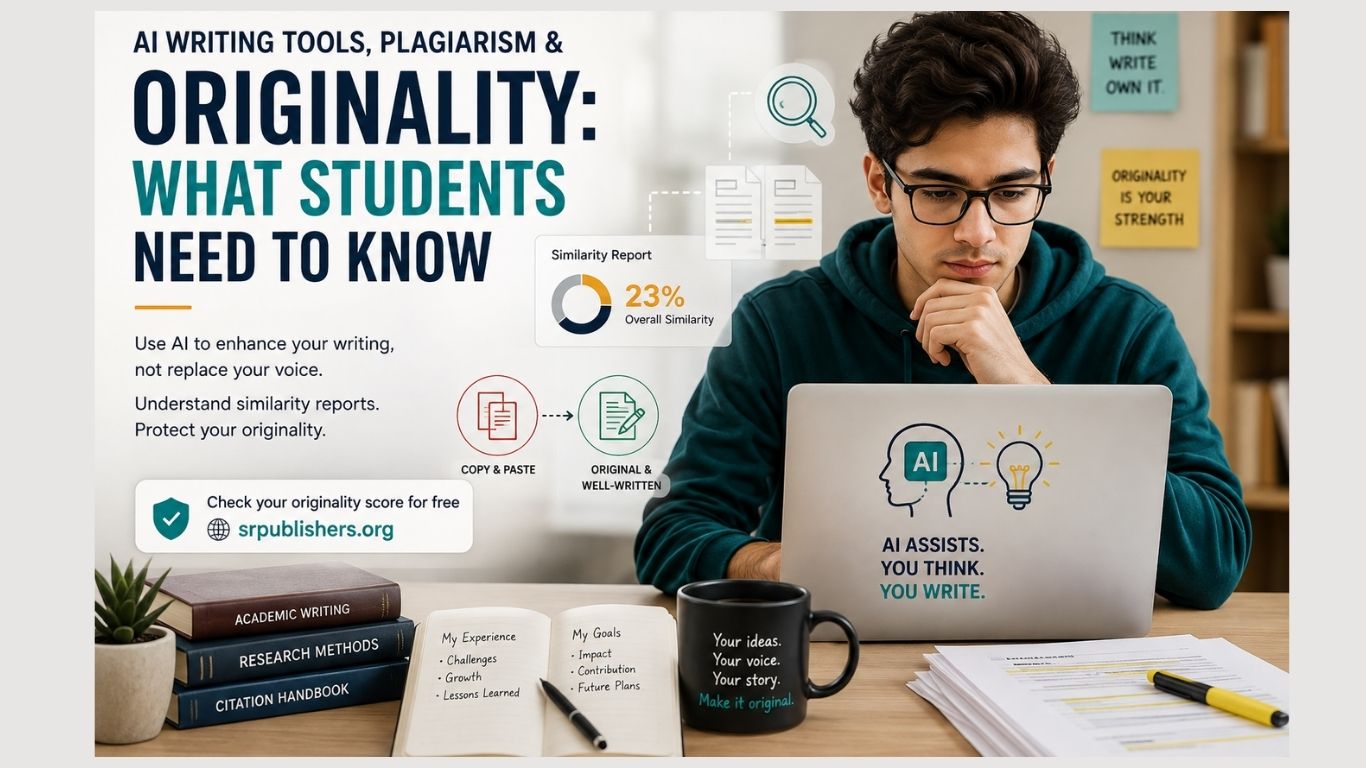
AI writing tools are now part of how almost every student drafts — whether that’s brainstorming an SOP opening, tightening a sentence, or checking grammar. That’s not automatically a problem. The problem is that “originality” now means something more complicated than simply avoiding copy-paste, and most students haven’t updated the way they think about it.
Originality Is Bigger Than “Did I Copy This?”
A plagiarism score is a single number standing in for several very different issues at once: direct copying, weak paraphrasing, reused personal work, and standard academic phrasing that happens to overlap with other writers.
A checker may flag all of these as matches, but it’s up to you to understand the difference between a harmless overlap and a genuine originality problem.
Must Find out That means a moderate similarity score, on its own, doesn’t tell you much. What matters more is the shape of the match. One long block copied from a single source is a serious concern, even if your overall similarity percentage is low. Several small, scattered matches to common academic phrasing across many sources are usually far less concerning, even if they nudge the percentage upward. In other words, don’t just ask, “What is my score?” Ask, “Why is my text matching?” Reusing a paragraph from your own earlier essay or paper can feel harmless — after all, it’s your own writing. But institutions may still consider it self-plagiarism if previously submitted work is reused without disclosure. The expectation is often that each submission represents original work prepared for that specific assignment or purpose. If you’re drawing on something you wrote before, check your institution’s rules, cite the earlier work where required, and rewrite the passage rather than simply pasting it in unchanged. Some sentence structures are so standard within a field that overlap is expected and mostly harmless — a description of a common statistical method is a good example. Plagiarism checkers can flag these phrases even when there is no meaningful copying involved. What deserves a closer look is when a substantial portion of your writing closely matches one specific source, rather than showing small overlaps with many different sources. This is one of the patterns most likely to cause genuine problems — and one of the hardest to detect in your own writing. You’ve changed the vocabulary and technically “rewritten” the source, but the sentence order, argument structure, or underlying expression is still borrowed. That can produce a similarity score low enough to look reassuring while the passage still relies heavily on someone else’s structure or reasoning. The solution isn’t simply to swap synonyms. Close the source, write the idea from memory in your own structure, and then compare your version with the original. If the structure still looks remarkably similar, you probably haven’t paraphrased deeply enough. It’s tempting to treat an AI-detection score the same way you’d treat a plagiarism score — as a clear pass or fail. It isn’t that simple. AI detectors estimate whether text resembles patterns associated with AI-generated writing. They do not have access to a definitive record of who actually wrote a passage. Research has repeatedly shown that these systems can produce both false positives and false negatives, so a detection score should not be treated as conclusive proof of misconduct. One Stanford study illustrates the problem particularly clearly. Researchers tested seven AI detectors on 91 human-written TOEFL essays. All seven detectors unanimously classified about 19.8% of those essays as AI-generated, while 97.8% were flagged by at least one detector. The researchers also found a strong bias against non-native English writers. Other research has reached a similar conclusion. A large evaluation of AI-text detection tools found inconsistent performance, including both false positives and false negatives, and concluded that the tested detectors were unsuitable as standalone evidence of academic misconduct. None of this means AI detectors are completely useless. It means they are signals, not verdicts. Treat a detection score the same way you’d treat a plagiarism score: as a reason to look more closely at the text, not as proof of anything on its own. Run a plagiarism check before you submit, not after a rejection makes you wonder what went wrong. SR Publishers’ free Plagiarism Checker highlights the sentences that are flagged, helping you understand the actual pattern behind your similarity score rather than looking at a number alone. Look at the pattern of matches, not just the percentage. One large block matched closely to a single source deserves more attention than several small, scattered matches involving common academic language. Rewrite close paraphrases from scratch. If you can’t explain an idea without looking back at the source, you probably haven’t made it your own yet. Close the source, explain the idea in your own structure, and then compare the result. Disclose and rewrite your own previous work rather than pasting it in unchanged. Your previous writing may still need to be treated as a source when you’re submitting a new academic assignment. Use AI tools to assist, not replace, your own thinking. Draft your ideas first, then use AI for grammar, structure feedback, or sentence-level tightening where your institution’s rules allow it. Don’t outsource the argument itself. Your personal narrative, specific examples, experiences, and reasoning are the parts of your writing that should genuinely come from you. Review structure and originality together. A strong SOP needs both a compelling structure and clean originality. Our free SOP Reviewer can help you evaluate the first, while the Plagiarism Checker helps you investigate the second. The rise of AI writing tools has made originality a skill that students need to actively manage, not a skill that has become less important. Similarity and AI-detection scores are starting points, not the whole answer. The real work is understanding what a report is actually telling you, checking the context behind flagged passages, and making sure the work you submit is genuinely built from your own thinking. Use AI where it helps you communicate more clearly — but don’t let it replace the ideas, experiences, and reasoning that make your writing yours. Start with a free originality check, fix what the report actually flags, and let AI assist your writing without replacing your voice. Check your originality score for free → click here 
Three Patterns That Trip Up Honest Students
1. Self-Plagiarism
2. Boilerplate Phrasing
3. Close Paraphrasing
Why AI Detectors Can’t Be Your Final Word
Best Practices for Staying Original

Final Thought