
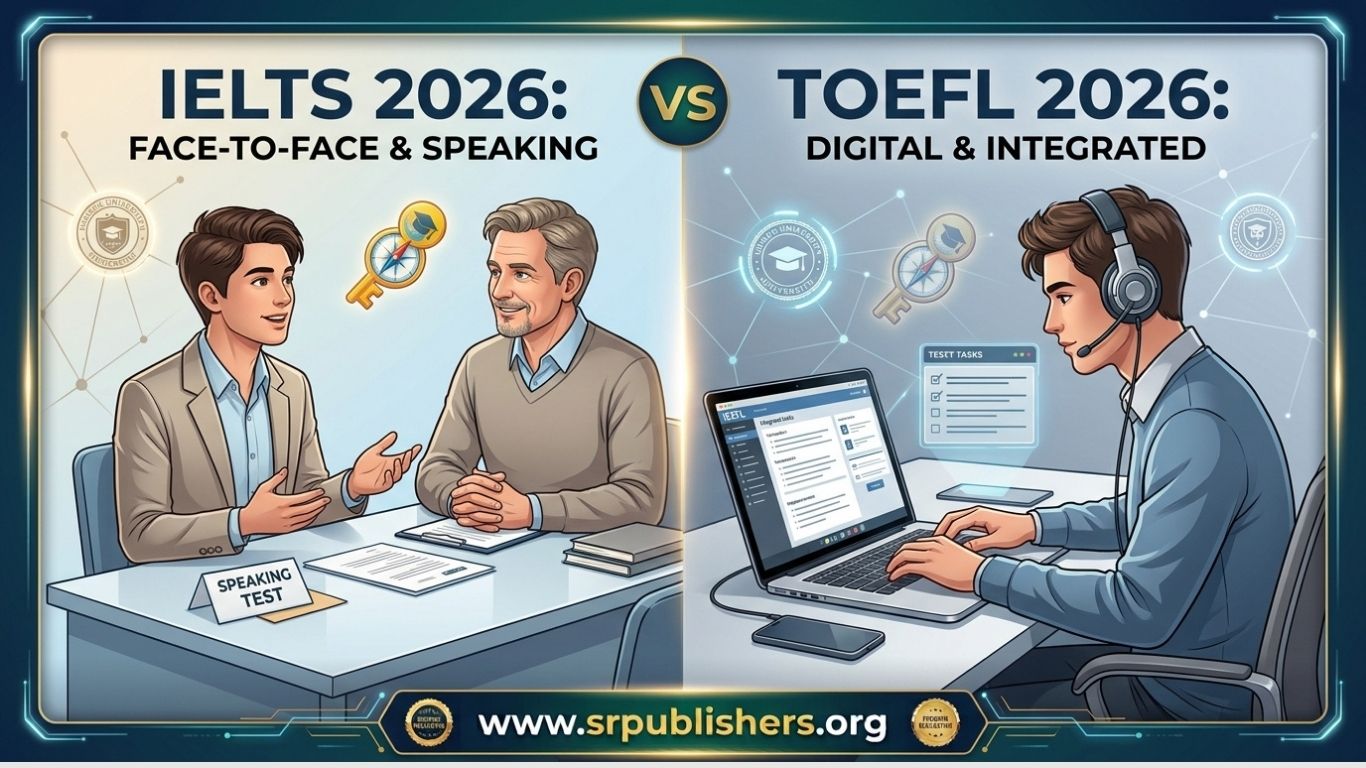
Choosing between IELTS and TOEFL has never been completely straightforward. Both are internationally recognized English proficiency tests, and both can be used for university admissions and other study-abroad purposes.
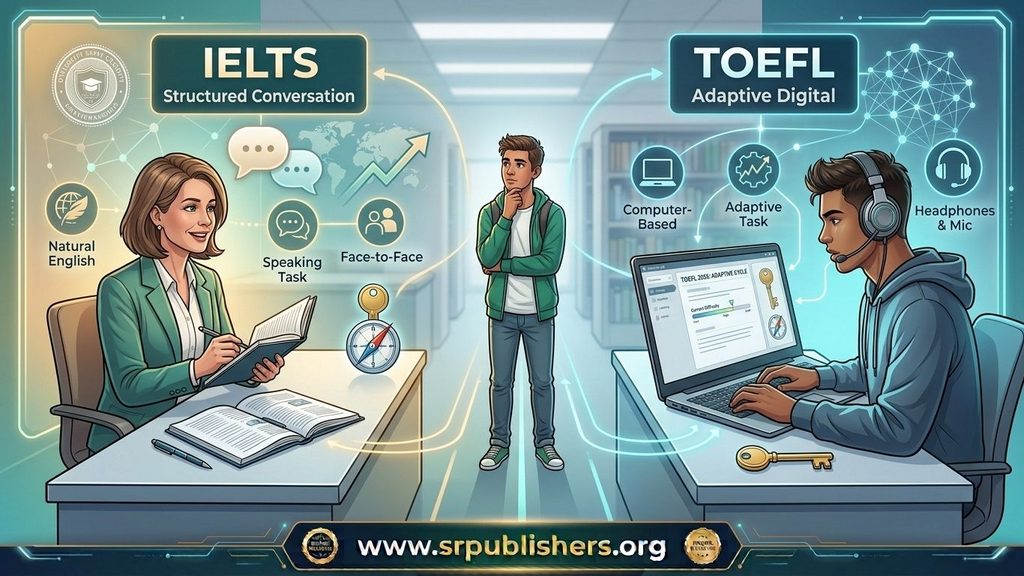
But in 2026, the comparison has become even more interesting.
The TOEFL iBT has undergone a major redesign, introducing a shorter test, adaptive Reading and Listening sections, new task types, and a new 1–6 scoring scale. IELTS, meanwhile, continues to use its familiar four-section structure and 0–9 band scoring system.
So, which test is easier in 2026—IELTS or TOEFL?
The honest answer is: neither test is objectively easier for everyone. The better choice depends on your English skills, test-taking style, comfort with computers, speaking preferences, and the preparation resources available to you.
Check list of scholarships without IELTS: Scholarships Without IELTS 2027: A Complete Guide for International Students
Also check the List of Best scholarships: 15 Best Scholarships for International Students (2026–2027 Guide)
Let’s compare IELTS and the new TOEFL 2026 section by section so you can decide which one fits you better.
IELTS vs TOEFL 2026: Quick Comparison
| Feature | IELTS | TOEFL iBT 2026 |
|---|---|---|
| Main sections | Listening, Reading, Writing, Speaking | Reading, Listening, Speaking, Writing |
| Test format | Computer or paper options may vary by location | Fully computer-based |
| Speaking | Face-to-face with an examiner | Recorded/computer-based tasks |
| Score scale | 0–9 bands | 1–6 scale |
| Test duration | About 2 hours 45 minutes | About 90 minutes |
| Reading | Fixed test structure | Multi-stage adaptive |
| Listening | Four fixed sections | Adaptive |
| Writing | Chart/letter + essay depending on test | Practical, shorter-form tasks |
| Preparation resources | Very extensive | Newer and still developing |
| Best suited to | Students comfortable with live conversation and traditional test formats | Students comfortable with computers, shorter tasks and adaptive testing |
Important: Test availability, delivery format, score reporting and acceptance requirements can vary by country, test center and institution. Always check the current requirements of the university or organization you are applying to.
What Changed in TOEFL 2026?
The biggest reason the IELTS vs TOEFL comparison looks different now is the 2026 TOEFL iBT redesign.
According to the material used for this comparison, the updated TOEFL format was introduced in January 2026 and brought several major changes.
The new version is considerably shorter, with the test taking roughly 90 minutes. Reading and Listening now use multi-stage adaptive testing, meaning the difficulty of later questions can change according to your performance.
The scoring system has also changed. TOEFL now uses a 1–6 scale aligned with the Common European Framework of Reference (CEFR), while the previous 0–120 score is being shown during the transition period.
The test also introduces more modern and practical task types.
That makes the new TOEFL quite different from the TOEFL many students may remember from older preparation books and videos.
IELTS, by comparison, retains its familiar four-skill structure and 0–9 band scoring system.
This difference is important because students preparing for TOEFL in 2026 should make sure that their study materials actually cover the new format, rather than relying entirely on older TOEFL preparation books.
IELTS vs TOEFL: Which One Is Easier?
There is no universal answer.
A student who enjoys speaking with people may find IELTS easier, while someone who becomes nervous during face-to-face interviews may prefer TOEFL.
Similarly, someone who is excellent at typing and processing information quickly may feel more comfortable with the new TOEFL, while a student who prefers traditional writing and fixed question formats may prefer IELTS.
Let’s look at each section.
1. Speaking: IELTS vs TOEFL
For many students, Speaking is the biggest difference between the two tests.
IELTS Speaking
IELTS Speaking involves a live conversation with a human examiner.
The Speaking test generally takes around 11–14 minutes and involves direct interaction.
This can be an advantage if you:
- Enjoy natural conversations
- Can express your ideas comfortably in front of another person
- Are good at responding spontaneously
- Prefer interacting with a human rather than speaking into a microphone
However, it can also feel intimidating if you become nervous when speaking directly to an examiner.
IELTS Speaking may be easier if:
You are naturally comfortable having conversations with people.
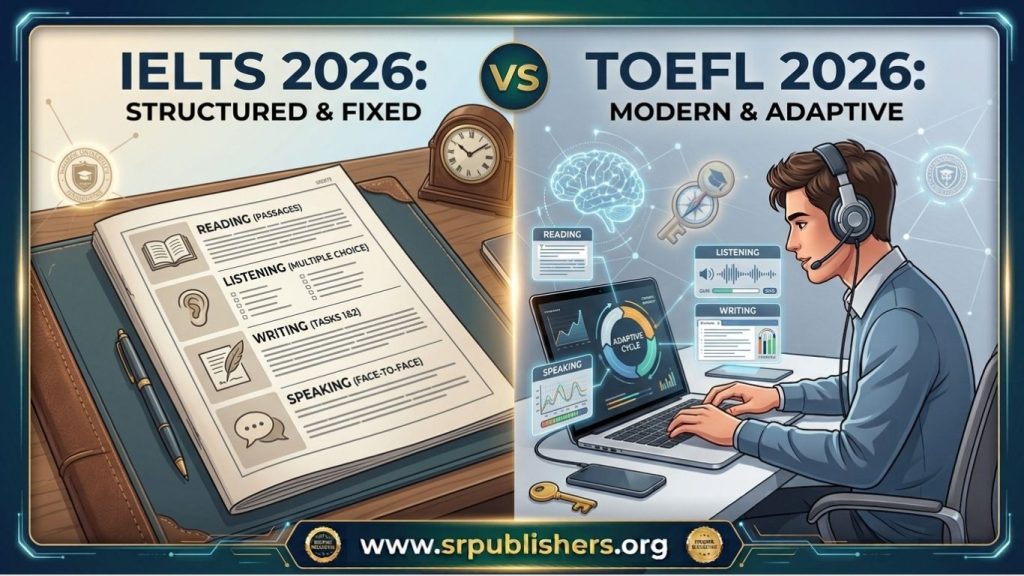
TOEFL Speaking 2026
The new TOEFL uses computer-based speaking tasks, including newer task types such as listen-and-repeat and virtual interview-style tasks.
Instead of having a traditional face-to-face conversation with an examiner, your responses are recorded through the computer.
This can be particularly appealing to students who feel nervous during live interviews.
You can focus on the task rather than trying to manage a conversation with another person.
However, recorded speaking also requires you to communicate clearly and efficiently without relying on real-time interaction.
TOEFL Speaking may be easier if:
You feel more comfortable speaking into a microphone than talking directly to an examiner.
2. Writing: Essays vs Practical Tasks
Writing is another area where the two tests differ significantly.
IELTS Writing
IELTS Academic Writing traditionally includes two major tasks.
Task 1 requires candidates to describe or summarize visual information such as a graph, chart, table, process or diagram.
Task 2 requires an essay response.
This format suits students who are comfortable organizing arguments, analyzing information and writing structured responses.
If you are good at traditional essay writing, IELTS may feel familiar.
IELTS Writing may be easier if:
- You are comfortable writing essays
- You can organize arguments clearly
- You are good at analyzing charts and graphs
- You prefer longer, structured writing tasks
TOEFL Writing 2026
The new TOEFL writing experience is more focused on practical and shorter-form communication.
The updated format includes tasks such as sentence-building, email-style writing and discussion posts, rather than relying on the older TOEFL writing structure alone.
This changes how students should prepare.
Instead of spending all their preparation time memorizing essay structures, TOEFL candidates need to practice producing clear and accurate written communication in different situations.
TOEFL Writing may be easier if:
- You type quickly
- You prefer shorter writing tasks
- You can respond to prompts quickly
- You are comfortable writing practical communication
3. Reading: IELTS or TOEFL?
Reading is another major difference.
IELTS Reading
IELTS Reading uses a fixed test structure with several passages and different question types.
You may encounter:
- Multiple-choice questions
- Matching headings
- Fill-in-the-blanks
- True/False/Not Given
- Matching information
- Other question formats
This variety can make IELTS Reading challenging.
Knowing the English language alone is not always enough. You also need to understand how different question types work.
For example, True/False/Not Given questions can be particularly confusing for students who are not familiar with the distinction between information that is false and information that simply isn’t provided.
IELTS Reading may be easier if:
You are comfortable dealing with different question formats and enjoy working through fixed passages.
TOEFL Reading 2026
The new TOEFL Reading section uses adaptive modules.
The difficulty can change depending on how you perform earlier in the test.
The updated format also uses shorter reading material across academic and more general contexts.
This creates a different testing experience from IELTS.
Instead of simply working through a fixed sequence of passages, you need to maintain accuracy while adapting to changing difficulty.
TOEFL Reading may be easier if:
- You prefer computer-based testing
- You are comfortable with multiple-choice questions
- You can work quickly under time pressure
- You adapt well when question difficulty changes
4. Listening: Which Test Is Easier?
Your listening style can also influence which test feels easier.
IELTS Listening
IELTS Listening contains several fixed sections involving conversations and monologues.
You listen to the recording while working through the questions.
One challenge is the variety of accents you may encounter, including British, Australian and other English varieties.
You also need to pay close attention because important information can appear quickly.
IELTS Listening may be easier if:
You are comfortable listening to different English accents and answering questions while following the recording.
TOEFL Listening 2026
The updated TOEFL Listening section is adaptive and includes contexts such as conversations, announcements and lectures.
The material focuses on practical and academic situations.
One important skill is note-taking and information processing.
Because the test is computer-based, you need to remain focused while processing spoken information and responding to questions on screen.
TOEFL Listening may be easier if:
- You are comfortable listening to academic conversations and lectures
- You take effective notes
- You prefer computer-based testing
- You can process information quickly
IELTS vs TOEFL 2026: Preparation Is a Major Difference
One factor students often overlook is the availability of preparation material.
And this is where IELTS currently has a major advantage.
IELTS Has a Mature Preparation Ecosystem
IELTS has been around for years, so there is an enormous amount of preparation material available.
Students can find:
- Official practice materials
- Books
- Practice tests
- YouTube lessons
- Online courses
- Vocabulary resources
- Speaking practice
- Writing samples
- Mock exams
- Strategy guides
There are also many teachers and preparation platforms that have spent years developing IELTS-specific strategies.
This makes it easier to find material for almost every part of the exam.
TOEFL 2026 Preparation Is Still Developing
The new TOEFL format is much newer.
That means students preparing for TOEFL in 2026 need to be more careful about the resources they use.
Older TOEFL books and videos may describe tasks and strategies from the previous format.
Official ETS practice material should therefore be prioritized when preparing for the updated exam.
Students may also find newer online videos, practice resources and AI-assisted practice exercises designed around the new format.
The key lesson is simple:
Do not prepare for the 2026 TOEFL using outdated TOEFL materials without checking whether the tasks still match the current exam.
Adaptive Testing: Does It Make TOEFL Easier or Harder?
Adaptive testing can sound complicated, but the basic idea is simple.
In the new TOEFL, certain sections can adjust their difficulty based on your performance.
If you perform strongly, you may encounter more challenging questions.
If you struggle earlier, the test can adjust accordingly.
This creates both an opportunity and a challenge.
The potential advantage
Strong performance can demonstrate a higher level of ability through more difficult questions.
The challenge
You cannot simply rely on memorized patterns.
You need to remain accurate from the beginning and manage your time effectively.
For students who perform well under changing difficulty levels, this could feel natural.
For students who prefer knowing exactly what type of question comes next, IELTS’s fixed structure may feel more comfortable.
TOEFL vs IELTS Scoring
Scoring is another major difference in 2026.
IELTS Scoring
IELTS continues to use the familiar 0–9 band scale.
Students receive scores for the four language skills, and an overall band score is calculated.
Because the 0–9 IELTS scale has been used for a long time, students can easily find examples of university requirements and preparation guidance.
TOEFL 2026 Scoring
The updated TOEFL uses a 1–6 scoring scale aligned with CEFR levels.
During the transition period, the previous 0–120 score is also being reported.
This means students who are familiar with the old TOEFL score system should pay close attention to the updated scoring information when checking university requirements.
Don’t assume that an old TOEFL score comparison automatically applies to the new system.
Which Test Gives Results Faster?
Result delivery can also matter if you are working with a university application deadline.
The updated TOEFL is designed to provide scores quickly, with results reported in approximately 72 hours according to the provided material.
IELTS results generally take longer, although the exact timing depends on the test format and center.
For students working close to an application deadline, faster results can therefore be an important practical advantage.
However, the most important factor should still be whether the test is accepted by your target institution and whether you can achieve the required score.
IELTS vs TOEFL: Which Test Should You Choose?
Instead of asking only “Which test is easier?”, ask:
“Which test matches my strengths?”
Here’s a simple decision guide.
Choose IELTS If:
- You are comfortable speaking with a real examiner.
- You prefer natural face-to-face conversation.
- You are good at essay writing.
- You are comfortable analyzing charts and graphs.
- You can handle different question types in Reading.
- You are comfortable with different English accents.
- You want access to a large amount of established preparation material.
- Your target institution specifically accepts or prefers IELTS.
Choose TOEFL 2026 If:
- You prefer a fully computer-based test.
- You feel more comfortable speaking into a microphone.
- You type quickly and accurately.
- You prefer shorter, practical writing tasks.
- You are comfortable with adaptive testing.
- You perform well with computer-based multiple-choice questions.
- You like shorter tests.
- You are comfortable preparing with newer materials designed specifically for the 2026 format.
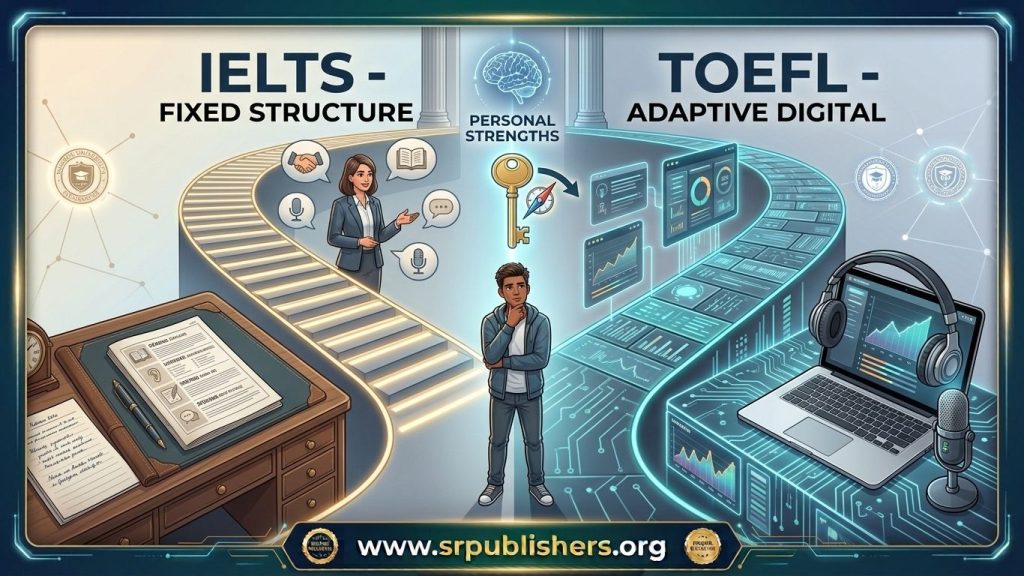
IELTS vs TOEFL 2026: Which One Is Actually Easier?
There is no single winner.
IELTS may feel easier for students who are strong in live communication, traditional writing and varied question formats.
The new TOEFL may feel easier for students who prefer computers, shorter tasks, recorded speaking and adaptive testing.
The biggest practical difference in 2026 may actually be preparation.
IELTS has a huge and mature preparation ecosystem. The new TOEFL, on the other hand, is still building its library of preparation resources because the format has recently changed.
So if you want a test with years of established preparation material, IELTS has an obvious advantage.
If you prefer a shorter, modern, computer-based experience and are comfortable adapting to a new format, TOEFL 2026 may be worth considering.
The Best Way to Decide: Take a Mock Test
Still confused?
Don’t choose based only on what someone tells you.
Try both.
Take one realistic IELTS practice test and one current-format TOEFL 2026 practice test.
Pay attention to:
- Which Reading section feels more natural?
- Which Listening format is easier for you?
- Do you prefer speaking with a person or a computer?
- Which Writing tasks feel more comfortable?
- Which test can you complete without feeling overwhelmed?
- Which test gives you a better practice score?
- Which test is accepted by your target universities?
Your answers will tell you much more than simply asking whether IELTS or TOEFL is “easier.”
Final Verdict
IELTS and TOEFL are both strong options for demonstrating English proficiency, but they are designed around different testing experiences.
IELTS offers a familiar structure, live human speaking assessment, a 0–9 band system and an enormous preparation ecosystem.
TOEFL 2026 offers a shorter, fully computerized and more adaptive testing experience, along with new task types and a 1–6 scoring scale.
So, don’t choose the test simply because someone says it is easier.
Choose the one that matches your strengths, your preferred testing environment, your preparation resources and the requirements of the universities you are targeting.
And before you register, check the latest official requirements of your target universities and take a practice test for both formats.
The easier test is usually the one that fits the way you perform best.