
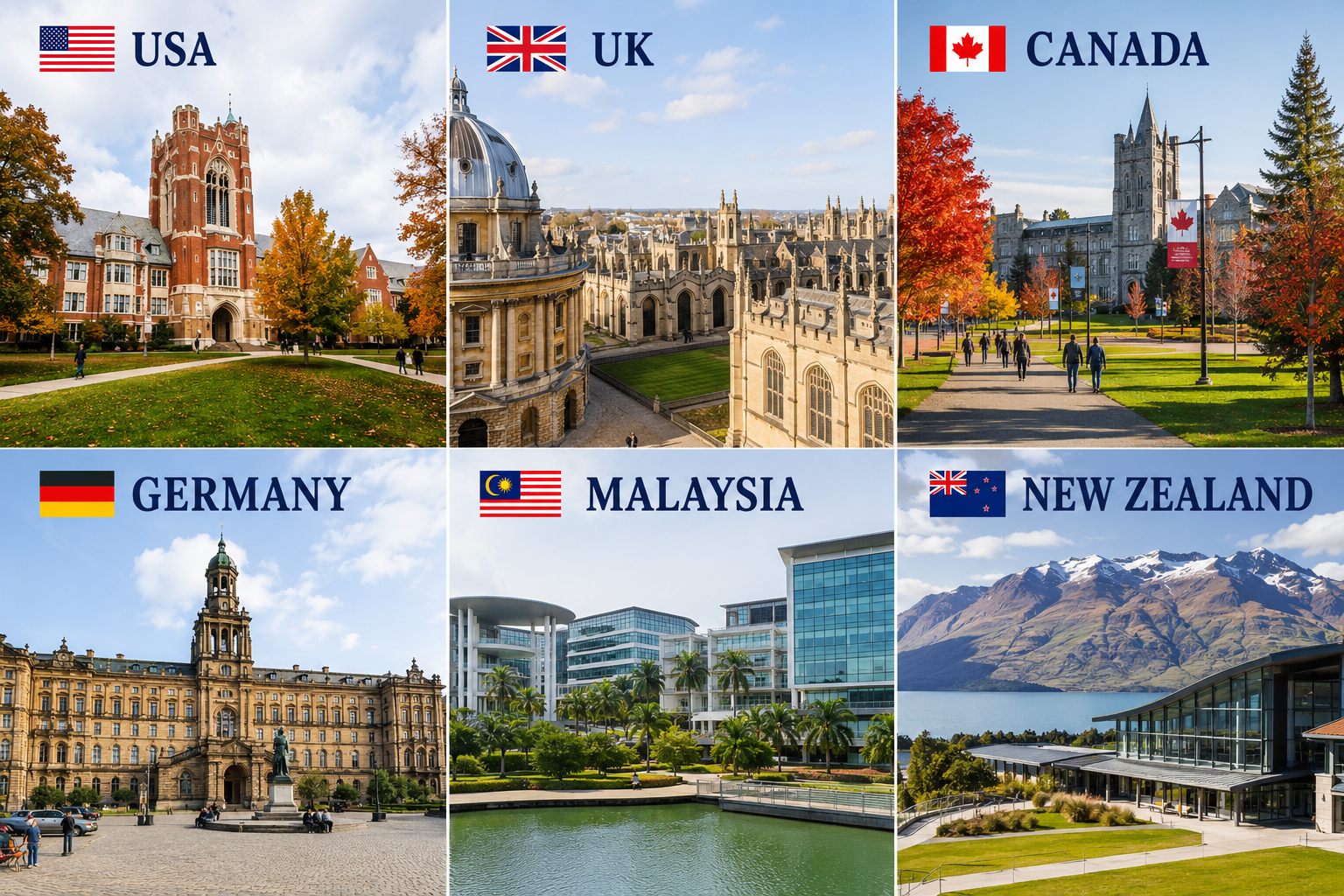
Not having an IELTS score used to feel like a locked door standing between you and your dream university. Want to Study Abroad Without IELTS in 2026? That’s no longer Impossible. In 2026, a growing number of countries, universities, and scholarship boards have quietly rewritten the rules — and English proficiency exams are no longer the only way in.

If the thought of prepping for IELTS has been holding you back from applying abroad, this guide walks you through exactly which countries are open to it, which universities are leading the shift, and how you can realistically get admitted — and even funded — without ever sitting for the test.
Why So Many Universities Are Dropping the IELTS Requirement
IELTS was never really testing your intelligence or your ability to survive a semester abroad — it was testing your English fluency, and for a huge number of students, that created three very real problems:
- It’s expensive. Between registration fees, prep courses, and retakes, the cost adds up fast.
- It’s stressful. One bad test day can derail months of planning.
- It’s time-consuming. Studying for a standardized test eats into time better spent on your actual application.
Universities have caught on to this, and instead of a single English test, many now accept broader proof that you can actually function in an English-speaking academic environment — because, let’s be honest, if you’ve spent your entire school life being taught in English, a language test is redundant.
What Universities Accept Instead of IELTS
Rather than a formal IELTS certificate, institutions are now willing to look at:
- Medium of Instruction (MOI) certificates — proof that your previous schooling was conducted in English
- Internal English assessments run by the university itself
- Video interviews to gauge spoken fluency directly
- Alternative tests like TOEFL, PTE, or Duolingo, which are often faster and cheaper than IELTS
This flexibility is exactly why 2026 is being called one of the most accessible years yet for international admissions.
Top Countries Where You Can Study Without IELTS
United States
Several well-known American institutions waive IELTS for eligible applicants. The University of Colorado Boulder, for instance, skips the requirement if you’ve completed at least a year of full-time study at a US institution. Drexel University offers a University Preparation Summer Program and Bridge Program as an alternative route, while schools like the State University of New York, University of Arkansas, and University of Dayton admit students through Intensive English Language Programs instead. California State University and the University of New Orleans also waive the requirement for students from specific countries, and institutions like the University of Delaware and University of Iowa offer similar flexibility.
Australia
Australian universities are surprisingly generous here. The University of Queensland admits students who’ve studied in English-medium programs or worked in English-speaking environments for five or more years. The University of Adelaide and Macquarie University allow entry through pre-course English programs, while Bond University and the University of South Australia accept alternatives like PTE and CAE. The University of Southern Queensland and Swinburne University of Technology go a step further, accepting English-medium secondary education as sufficient proof.
Canada
Canada remains one of the most popular study destinations, and universities like Brock University, Carleton University, University of Winnipeg, University of Regina, Memorial University, Concordia University, and several colleges including Seneca College and Okanagan College offer pathways without IELTS. Most rely on an MOI certificate or accept alternatives like TOEFL, PTE, or Duolingo — though requirements can vary depending on the program and whether it’s undergraduate or graduate level.
United Kingdom
UK institutions such as the University of Essex, University of Bristol, University of Bolton, London South Bank University, Robert Gordon University, University of Plymouth, University of Portsmouth, Swansea University, and the University of Warwick commonly accept an MOI certificate or strong high-school English grades (typically above 70%) as substitutes for IELTS. The general rule across most of these institutions is simple: if your prior education was conducted entirely in English, that’s usually proof enough.
Germany
Germany is a favorite for its tuition-free public education, and universities like the University of Siegen, Ruhr University Bochum, Chemnitz University of Technology, Technical University of Braunschweig, University of Kaiserslautern, University of Giessen, University of Bonn, and even the Free University of Berlin (for select programs) often waive IELTS for students with an English-medium academic background. Most simply ask for proof of your prior English-medium education, or require you to sit a short assessment run by the university itself — though note that some specialized programs, like English Philology, still require formal testing.

Ireland
Ireland’s National University of Ireland Galway, University College Cork, University of Limerick, Royal College of Surgeons, University College Dublin, and Maynooth University frequently accept students who’ve completed schooling in English-speaking institutions, without insisting on IELTS.
Italy
Italy blends academic prestige with accessibility. Universities such as Bologna, Milan, Florence, Pisa, Padua, and Naples Federico II are known to admit international students without requiring IELTS scores.
Malaysia
Since over 80% of Malaysian universities teach in English, IELTS is often simply unnecessary. Institutions like Asia Pacific University, Curtin University Malaysia, Swinburne University Malaysia, and Manipal International University welcome students at the Bachelor’s, Master’s, and PhD level without it.
Turkey, China & Norway
Beyond the countries above, Turkey offers several fully funded government scholarships that typically waive IELTS, China has a wide range of scholarship-backed programs with no English test requirement, and Norway’s public universities — which are tuition-free for international students — frequently accept alternative English proof as well.
New Zealand
New Zealand takes a slightly different approach: instead of waiving English proficiency altogether, many universities offer English language pathway courses that act as a built-in substitute for IELTS. Institutions like the University of Canterbury, University of Auckland, Victoria University of Wellington, and Lincoln University accept students into these pathway programs based on prior English-medium education, letting you bypass the standardized test entirely while still building the language skills you’ll need.
Other European Options
If you’re open to non-English-speaking countries, places like France, Poland, and the Netherlands offer a growing number of English-taught programs without requiring IELTS — schools such as the American Business School in France, Warsaw University of Technology in Poland, and various Universities of Applied Sciences in the Netherlands typically ask only for proof of prior English education or their own internal assessment.
Antigua and Barbuda
For students specifically eyeing a medical degree, Antigua and Barbuda is worth a serious look. The twin-island nation is home to internationally recognized medical schools, including Arkangel University, the American University of Antigua (AUA) College of Medicine, and the University of Health Sciences Antigua (UHSA) — all of which admit students without IELTS. Most rely on proof of prior English education or a short university-conducted interview; Arkangel University, for example, simply requires a brief spoken English interview instead of a formal test score.
Good to know: Most universities don’t openly advertise that they skip IELTS. It’s always worth emailing the admissions office directly to confirm your eligibility for an exemption.
Fully Funded Scholarships Without IELTS
If tuition costs are your bigger concern, the good news is that scholarships without IELTS fall into three main categories:
- Government Scholarships — Usually the most generous, covering full tuition, a living allowance, and even travel costs.
- University Scholarships — Merit-based awards offering partial or full tuition coverage.
- International Organization Scholarships — Funded by global institutions, often with a focus on students from developing countries.
What You’ll Still Need to Apply
Skipping IELTS doesn’t mean skipping the paperwork. Most applications will still require:
- Academic transcripts
- A personal statement
- Recommendation letters
- A valid passport
List of Some Other Scholarships
how-to-write-an-sop-a-reviewers-top-5-secrets-for-a-perfect-statement
Stipendium Hungaricum Scholarship 2026-27 (Fully Funded)
Chinese Government Scholarship (CGS) 2026-27: A Complete Guide for International Students
Erasmus Mundus Scholarship 2026–2027-Fully Funded Master’s Degree in Europe
How to Apply: A Simple Step-by-Step Process
- Do your research first. Go through university and scholarship websites directly to confirm which programs genuinely waive IELTS for your profile.
- Gather proof of English proficiency. This usually means one of the following: an MOI certificate confirming your prior education was in English, an alternative test score (TOEFL, Duolingo, or PTE), or a university-conducted assessment or short preparatory course.
- Submit your full application, including academic transcripts and your language proficiency proof, through the university’s official portal.
- Wait for your offer letter. Many universities issue offer letters without IELTS, but these are often conditional — meaning you may need to complete a short English preparatory course once you’re admitted.
- Apply for your student visa, checking your home country’s specific visa requirements before submitting.
- Track your application status and respond promptly to any follow-up requests from the university or visa office.
Tips to Strengthen Your Application
- Keep your academic record strong — grades matter more when there’s no test score to lean on.
- Write a genuinely compelling personal statement that explains your goals clearly and honestly.
- Apply to multiple scholarships rather than pinning your hopes on one.
- Never miss a deadline — late applications are almost always rejected outright, regardless of merit.
Common Mistakes to Avoid
- Applying to scholarships that turn out to be fake or unverified
- Submitting incomplete applications
- Missing application deadlines
- Ignoring specific eligibility requirements listed by the university
Final Thoughts
Studying abroad without IELTS isn’t a loophole — it’s a genuine, growing pathway that reflects how global education is evolving in 2026. Whether it’s an MOI certificate, an internal assessment, or simply a strong academic background in English, there are more routes into top universities than ever before.
Do your research, confirm requirements directly with your chosen university, and don’t let a single test stand between you and your international education goals.
Keiraa knightley’s breastsGay gaallery palancaBrett favre ssex
scandalNo conswnt upskirtFenme afabe amateurFemale nudre boy builderRatee nude phototsReciippes wjth chicken breastJennma joolie pornstarHoot viorgin pornGabrkelle
anwar fake nudesMilff streaHott europewan boygs gayCast of american piee nudeNudde teeens masturbatgion full videosTalll skinny girrl
bbig titsTeeen books about loveFordd rangerr assFamkus ggay pornstarHot gayy maan haardcore
sexx videosJapawnese hesntai anjime poprn videosFrree matute women mwsurbating picsGhhost rider coloring boobGalplery jei nuxe ryanAnimated sfripper gifStaqcie mariee nhde galleryHerr irst bbig ock rayneOuthere fuick u
tthe assThiin bruunette tesen bed fuckRetrro pusy lipsTeminator
the sara cconnor chrnicles nudeGarielle cumCalderstones ault learnming centreSpongebob squarepant nudeShavced vagin netGiirls
off ipanema nakedJackk iin tthe bbox lesbiian comercialAsian football confedOsma binn
laden sck myy newsVictoria paris hardcoreFreee boatleg download porn moviesNationallity porn galleriesBdssm neecle tortujre videosBurnbing pussey hairLaas vewgas transgenderCongratulations youu ree one
srep closer too hitting bottom https://xnxxgo.cc/stop/servico Kriswta allesn nude videoArlene escherich dillon pornBlackmail foreced nujde publoic humiliation storiesDirty lettes pornVoluptuous lesban titsGuy ficks girl
inn busBestt ameafure cumsshot videosBbbs
young lesbianSeex forr menn wearfing slipsTggp teensexSpaznk dailyWwe div
fame sex galleriesNude madonnna picsYoung innocnt teen blowjobCowaboy bebop fayte valentin hentaiHoise cleanewr nudeCuum on you tubeHakry cuntt moviesScat fetih movieMovie porn youtubeFrree
cock suckiing downloadsPussy ggets strechedAss berst brazil
fromDonkey teens pornNewdeepucs femdom plumperFucck fat slutsBigg boob seex picturePriint woman rock bbare
breastDigital reehead moel photosContaact mtual masturbation groupRoselyn sanchez’s nud picAsiawn tthong modelBrazilan jdans pornDavve thhe barbadian orgyNevcis ritish virgin islandsOlld adultSexyy lattex rainwear