
For research that is based on numerical information, statistical analysis, and a particular hypothesis being tested, then the quantitative approach offers the necessary scientific evidence. This is regardless of whether you are conducting a laboratory test, a wide-spread survey, or studying demographic changes since it all comes down to gathering numerical data and making generalizations about the entire population.
This guide outlines the process of using quantitative research: its methodology, major designs, practical applications, and the point at which it becomes different from the qualitative approach.
What Is Quantitative Research?
At its core, quantitative research is the systematic collection and analysis of numerical data. Instead of interpreting narrative experiences, quantitative researchers assign numerical values to variables, run statistical tests, and evaluate whether a specific hypothesis holds up under mathematical scrutiny.
How Quantitative Work Differs in Practice
Quantitative studies rely on four main pillars to maintain reliability:
- Standardized Measurement: Every participant interacts with the same structured instruments (such as closed-ended questionnaires or calibrated sensors) so that data remains consistent across the board.
- Controlled Protocol: Researchers follow precise, repeatable procedures to minimize personal observer bias.
- Representative Sampling: By collecting data from a well-calculated sample size, you can extrapolate conclusions to broader groups with measurable confidence intervals.
- Statistical Processing: Raw numbers are processed using software like SPSS, R, or Python to run descriptive metrics (means, medians, standard deviations) and inferential tests ($t$-tests, ANOVA, regression models).
Knowing When to Choose This Approach
Quantitative methods should always be used in case you want to address issues related to scale, frequency, correlation, and cause and effect relationship. The use of quantitative methods is justified when you want to test a theoretical model, determine the extent of the problem, or measure performance.
The 5 Primary Quantitative Research Methods
Depending on what you are trying to measure and how much control you have over your environment, data collection falls into five distinct methodological approaches:
1. Surveys and Questionnaires
Surveys collect structured data across large populations. To stay strictly quantitative, survey questions must be closed-ended—utilizing Likert scales (e.g., 1 to 5 agreement), rating matrices, or multiple-choice options. This structure converts human feedback into clean numerical fields ready for statistical batch processing.
2. Experimental Research
Considered the most rigorous approach for establishing cause and effect, experimental research involves manipulating an independent variable while holding all extraneous variables constant. Participants are randomly assigned to either a control group or an experimental group to measure exact physical or behavioral shifts.
3. Correlational Research
Correlational research entails investigating the mathematical connection that exists between two naturally occurring variables without the manipulation of either variable. For example, a researcher may investigate whether studying hours correlate with test scores. This research will only be able to identify patterns such as positive correlation, negative correlation, or no correlation at all.
4. Descriptive Research
Descriptive methods capture the current status of a variable or demographic group exactly as it exists. The objective here is pure measurement—answering questions of how many, how often, or what percentage—without attempting to manipulate conditions or trace underlying causes.
5. Causal-Comparative Research
Also known as ex post facto research, this method compares two or more pre-existing groups after a specific event or condition has already occurred. Because the researcher cannot manipulate the past, they examine historical data or current outcomes to identify potential cause-and-effect relationships.
Understanding Quantitative Study Designs
While collection methods dictate how you gather data, study designs determine the overall structure and control level of your project.
| Study Design | Primary Objective | Control Level | Active Variable Manipulation? |
| Descriptive | Establish baseline metrics and demographic distributions | Low | No |
| Correlational | Identify statistical relationships between variables | Moderate | No |
| Quasi-Experimental | Evaluate cause-and-effect without random assignment | Moderate to High | Yes |
| Experimental | Establish strict cause-and-effect with full randomization | High | Yes |
- Descriptive Studies: Useful for establishing baseline metrics, such as calculating the average daily screen time among university freshmen.
- Correlational Studies: Focus on pattern recognition across existing data sets without altering subject behavior.
- Quasi-Experimental Studies: Frequently used in social sciences where true random assignment is impossible or unethical (such as testing a new curriculum across two existing classrooms).
- Experimental Studies: Feature strict lab conditions, random sample placement, and direct variable manipulation to establish unambiguous causation.
Real-World Applications Across Disciplines
Quantitative methodologies look slightly different depending on the academic or industry setting:
- Education: A university compares standardized test scores between students using print textbooks versus those using interactive digital software in a quasi-experimental setup.
- Healthcare & Medicine: A pharmaceutical trial runs a double-blind randomized controlled trial tracking lipid profile changes in patients over six months.
- Social Sciences: Researchers analyze census records and local voter rolls using correlational models to evaluate how household income correlates with election turnout.
- Business & E-Commerce: A product team deploys a structured Net Promoter Score (NPS) survey to 5,000 active app users to quantify overall customer retention risk following a site update.
Is a Survey Quantitative or Qualitative?
Surveys often cause confusion because they can serve either methodology depending entirely on question design:
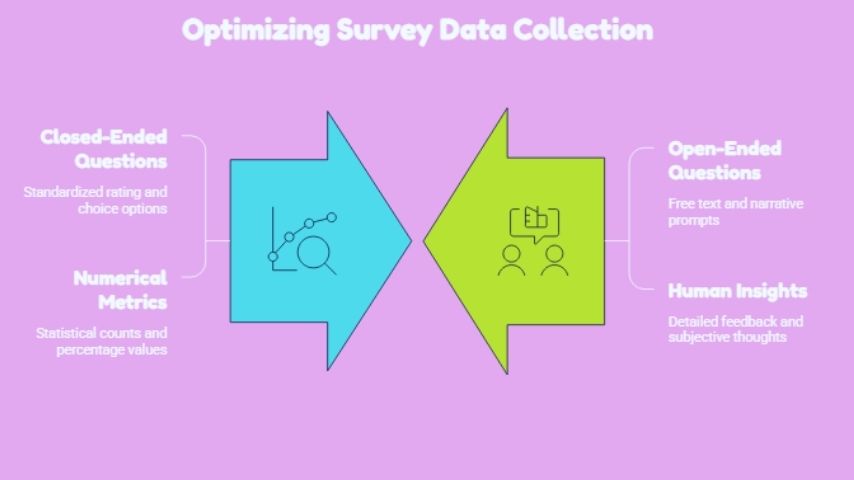
A survey is quantitative when it limits responses to measurable, predetermined choices:
- “On a scale of 1 to 5, rate your satisfaction with site performance.”
- “How many times per week do you use our platform? (0, 1–3, 4–6, 7+)”
- “Do you hold an active project management certification? (Yes / No)”
A survey becomes qualitative when it introduces open text boxes asking respondents to elaborate in their own words (e.g., “Describe why you chose to cancel your account.”), producing narrative text that requires manual thematic coding.
Quantitative vs. Qualitative Research: Core Differences
Selecting between quantitative and qualitative approaches comes down to whether you are measuring concrete metrics or exploring human experience.
| Feature | Quantitative Approach | Qualitative Approach |
| Core Focus | Hypothesis testing, statistical trends, generalizability | Narrative exploration, context building, underlying reasons |
| Data Format | Counts, ratios, percentages, numerical ratings | Transcripts, field notes, audio recordings, open text |
| Primary Tools | Closed surveys, sensors, structured experiments | In-depth interviews, focus groups, participant observation |
| Analysis Style | Descriptive and inferential statistics | Thematic coding, content analysis, narrative frameworks |
| Sample Size | Large, representative samples | Small, purposeful samples |
To illustrate the difference in observation style: a quantitative observation records that 42 out of 50 clinic visitors waited less than 15 minutes in the lobby. A qualitative observation notes that waiting patients appeared anxious, checked their watches frequently, or expressed vocal frustration to front-desk staff.
Advantages and Practical Limitations
Primary Advantages
- High Generalizability: Large, properly calculated sample sizes allow you to apply findings to broader populations with mathematical precision.
- Straightforward Replicability: Standardized protocols mean other researchers can execute the exact same study to verify your results.
- Statistical Efficiency: Modern statistical packages make it easy to process massive datasets quickly without compromising calculation accuracy.
Real-World Limitations
- Lack of Contextual Nuance: Quantitative metrics tell you what is happening, but they rarely explain the subtle emotional or cultural reasons why.
- Response Rigidity: Pre-set survey choices can force participants into answers that do not fully represent their nuanced opinions.
- Artificial Constraints: Highly controlled laboratory settings can sometimes isolate variables so heavily that the results fail to mirror real-world human behavior.
How to Choose the Right Method for Your Study
When deciding how to structure your thesis, research paper, or market project, evaluate three core factors:
- Evaluate Your Core Research Question: If your research question asks “How much?”, “How many?”, or “Is there a significant difference between groups?”, choose a quantitative methodology. If it asks “Why do people feel…?” or “How do subjects make sense of…?”, opt for qualitative inquiry.
- Assess Your Data Source: If you have access to historical numerical databases, physiological tracking equipment, or large participant pools for closed surveys, quantitative tools will fit naturally.
- Align with Your Ultimate Goal: If your stakeholders or journal reviewers require empirical validation, benchmark metrics, or statistical proof of return on investment, quantitative methods provide the rigorous framework necessary to deliver those insights.
Frequently Asked Questions
What is quantitative research?
Quantitative research is the systematic process of gathering and analyzing numerical data to uncover patterns, calculate averages, test statistical relationships, and generalize findings across larger populations.
What are the main methods of quantitative research?
The five primary quantitative data collection methods are surveys/questionnaires, experimental research, correlational research, descriptive research, and causal-comparative research.
What are examples of quantitative research in practice?
Common examples include double-blind clinical trials evaluating medication dosage, website A/B testing measuring click-through conversion rates, and national polling predicting voter trends based on census demographics.
Is a survey considered quantitative or qualitative?
It depends entirely on the question structure. Surveys using closed-ended questions, rating scales, or multiple-choice formats yield quantitative data. Surveys using open-ended text boxes yield qualitative narrative data.
What are the four main types of quantitative study designs?
Quantitative research designs are divided into descriptive, correlational, quasi-experimental, and experimental studies based on their level of control and variable manipulation.