

Lots of PhD applicants have great grades, strong recommendation letters, and good experience — and they still get a rejection email. Most of the time, it’s not because they weren’t smart enough. It’s because their research proposal wasn’t clear, wasn’t fresh enough, or just didn’t feel realistic.

Here’s what universities really want: they don’t expect a perfect, fully-worked-out research plan. They just want to see that you can spot a real problem worth studying, and that you have a real idea of how you’d go about looking into it. If you’re wondering how to write a PhD research proposal that actually gets noticed, this guide walks you through it step by step, without the fluff.
Check this also: Best Countries for Fully Funded PhD Scholarships (2026)
Also Check: A complete study abroad timeline it helps you arrange your documents at perfect timing
What Is a PhD Research Proposal?
A research proposal is a short paper — usually somewhere between 1,500 and 3,000 words — where you explain what you want to research, why it matters, and how you plan to do it.
A few things worth knowing early on:
- It’s not your thesis. A thesis is the finished work, written after years of research. A proposal is the plan you write before any of that starts.
- Its main job is to show promise, not give final answers. No one expects you to have solved your research problem before you’ve even begun your PhD.
- Universities ask for one because it tells them if your idea is worth funding, if it matches a supervisor’s area of work, and if you can realistically finish it in the time you’re given.
Why the Research Proposal Matters So Much
It’s easy to treat the proposal like just another form to fill in. It isn’t. Here’s what it’s really doing behind the scenes:
- It convinces a possible supervisor that your project is worth taking on and matches what they work on
- The admission committee uses it to see if you can think like a researcher, not just a student
- Scholarship committees use it to judge how much your research could matter
- Funding groups mainly care about one thing: can this actually be done in the time and money available?
In short, this one paper is doing the work of your grades, your interview, and your funding pitch, all at once.
Before You Even Start Writing
This is the part most guides skip, and it’s honestly where a lot of proposals go wrong — even before a single word gets typed.
- Pick a research area you actually care about, not just one that sounds impressive
- Read recent papers in that area (ideally from the last 2–3 years), so you know what’s already been done
- Find the gap — what hasn’t been answered yet, or what’s been answered poorly
- Check your target supervisor’s own work — does your idea really connect with what they focus on?
- Look at what the university cares about — some departments love applied research, others lean more toward theory
Skipping this step is the biggest reason proposals end up sounding generic. Do this part well, and the writing gets a lot easier.

The Standard Structure Behind Every Strong PhD Research Proposal
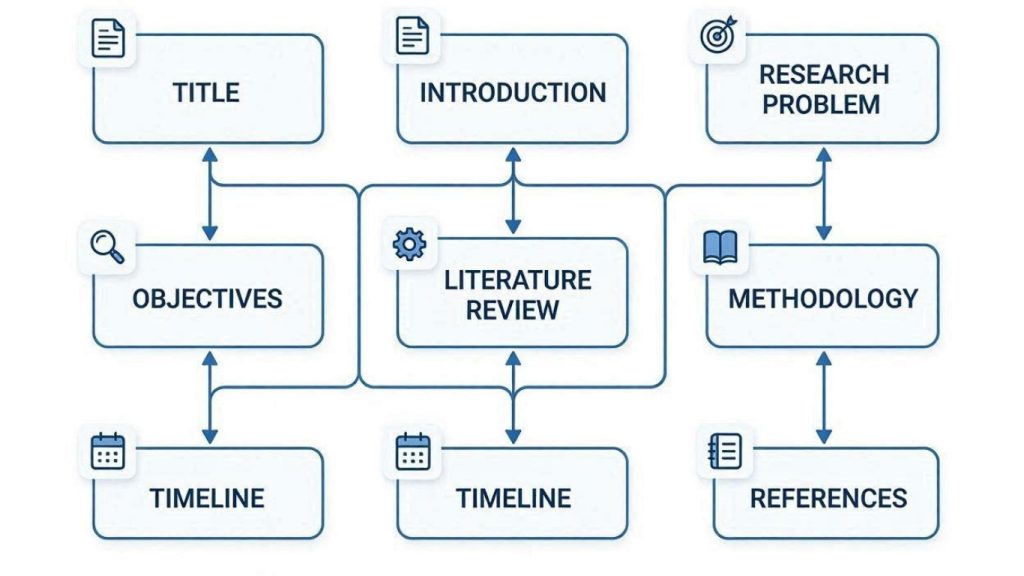
Most universities expect some version of this layout, even if the section names change a little:
| Section | What It Covers |
|---|---|
| Title | Your research topic in one clear line |
| Introduction | Background and context |
| Research Problem | The exact issue you’re looking at |
| Research Questions | What you’re actually trying to find out |
| Objectives | Your clear, specific goals |
| Literature Review | What’s already known in this area |
| Methodology | How you’ll actually carry out the research |
| Timeline | A realistic project schedule |
| Expected Outcomes | What your research could add |
| References | Sources you’ve used |
\want to know more about: How to Create an International Standard CV
Step-by-Step: How to Write a PhD Research Proposal
Once you know the structure, actually writing it becomes a lot less overwhelming. Here’s how to work through it one step at a time.
Step 1: Choose a Focused Topic
Big, broad topics (“Climate Change and Society”) are almost impossible to properly research in one PhD. Narrow it down until you could explain your whole project in just two sentences.
Step 2: Write a Strong Introduction
Give the reader some context first — why does this area matter right now? Then move into your specific angle. Keep it short; this isn’t the place to show off everything you know.
Step 3: Clearly State the Research Problem
Explain the exact issue you’re tackling in plain, simple words. If someone outside your field can’t follow it, it’s not clear enough yet.
Step 4: Build Your Research Questions
These should come straight from your problem statement. Usually, 2–4 focused questions work better than one huge, vague one.
Step 5: Set Your Research Objectives
Turn your questions into clear, measurable goals. “Understand X” is weak. “Measure the effect of X on Y across Z” is strong.
Step 6: Review the Existing Research
Show that you know what’s already been written, and more importantly, where it falls short. This is where you prove the gap you found earlier is real.
Step 7: Explain Your Methodology
This is often the section that makes or breaks a proposal. Be clear about whether you’re using:
- Qualitative methods (interviews, case studies, theme-based analysis)
- Quantitative methods (surveys, statistics, experiments)
- Mixed methods (a mix of both)
Whatever you pick, explain why it fits your questions best, not just what it is.
Step 8: Describe Your Expected Outcomes
What might your research add to the field? It doesn’t need to be groundbreaking — even a small, clear contribution is fine, as long as it’s honest and specific.
Step 9: Build a Realistic Timeline
Break your PhD years into phases (reading, collecting data, analyzing, writing). Committees can tell right away when a timeline was just copied and pasted rather than actually planned out.
Step 10: Add Your References
Stick to one citation style (check what your department prefers), and make sure your sources are recent and relevant, not just there to fill space.
How Research Proposals Differ Across Countries
This part trips up a lot of applicants who assume one style works everywhere. It doesn’t.
- UK: Proposals are usually shorter (around 1,500–2,000 words) and are often sent in before you’re even accepted, since UK PhDs run 3–4 years and expect a fairly settled plan from day one.
- USA: Many programs accept you first, then let you shape your proposal further after coursework and with your advisor’s help — so the first version can be more open-ended.
- Germany: Since many PhDs run through a specific professor or research group, your proposal often needs to fit closely with that group’s current projects, not just your own interest.
- Australia: Proposals are usually reviewed together with your Research Training Program (RTP) application, so how realistic your plan is gets extra attention.
The main takeaway: always check what your target university actually expects, instead of copying what worked for a friend who applied somewhere else.
Also Explore these topics:
Study Abroad Without IELTS in 2026: Discover 10+ countries & How to Apply
How to Write an SOP: A Reviewer’s Top 5 Secrets for a Perfect Statement Of Purpose
Chinese Government Scholarship (CGS) 2026-27: A Complete Guide for International Students
How to Apply for Stipendium Hungaricum Scholarship 2026-27
How Scholarship Committees Actually Judge Proposals
Scholarship reviewers usually aren’t reading for beautiful writing — they’re checking for a few clear things:
- Is the topic fresh, or just a slightly reworded version of dozens of others?
- Does it show awareness of current research, not old, outdated sources?
- Is the plan realistic given the scholarship’s time and money?
- Does the applicant’s background actually support this exact project?
- Could this research realistically lead to something useful?
Committees often go through dozens, sometimes hundreds, of proposals each round, so being clear usually beats being clever.
Common Mistakes to Avoid
- Picking a topic that’s way too broad
- Not showing a clear research gap
- A weak or unrealistic plan for how you’ll do the research
- Goals that aren’t actually measurable
- Leaning too much on old, outdated sources
- Basic grammar and formatting mistakes
- Ignoring the university’s specific formatting rules
Any one of these can weaken an otherwise strong application. Reviewers see them all the time, and they stand out fast.
Tips to Make Your Proposal Stand Out
- Show real originality, not just a repackaged version of an old study
- Use recent sources, ideally from the last few years
- Make every goal specific and measurable
- Keep your argument flowing logically from problem to method to outcome
- Prove it’s doable — don’t plan a 10-year project for a 3-year PhD
- Match your topic with your target supervisor’s actual area of work
- Follow the university’s formatting rules exactly, including word count
Checklist Before You Submit
Go through this list before you hit send:
- Topic is specific, not too broad
- Research problem is explained in plain words
- Research questions connect directly to the problem
- Goals are measurable, not vague
- Literature review clearly shows the gap
- Methodology matches your research questions
- Timeline is realistic for how long your program runs
- References are recent and properly formatted
- Word count matches what the university asked for
- You’ve proofread for grammar and formatting mistakes
- Proposal matches your target supervisor’s area of research
Research Proposal vs. Statement of Purpose vs. Study Plan
People mix these three up all the time, but they’re not the same paper:
| Document | Main Focus | Typical Length |
|---|---|---|
| Research Proposal | Your specific research problem, questions, and methodology | 1,500–3,000 words |
| Statement of Purpose | Your personal and academic journey, motivations, and goals | 500–1,000 words |
| Study Plan | A broader look at what you plan to study and why, often used for scholarship applications | 500–1,500 words |
If a university or scholarship asks for more than one of these, don’t just repeat yourself — each paper is answering a different question about you.
Free Tools for Finding Research Gaps
- Google Scholar — search recent papers and check their “cited by” count to see what’s being built on
- University repositories — many universities post recent theses and dissertations for free
- Review papers and meta-analyses — these often list open questions in a field directly
- Conference proceedings — a good way to spot new topics before they show up in major journals
A Simple Outline to Follow
Here’s the natural flow your proposal should follow, section by section:
Title → Introduction → Problem Statement → Objectives → Literature Review → Methodology → Timeline → References
Each part should build naturally on the one before it — your introduction sets up the problem, the problem leads to your goals, and so on. If a reader can follow that chain without getting lost, your structure is working.
Frequently Asked Questions
How long should a PhD research proposal be? Usually between 1,500 and 3,000 words, though this changes by country and university — always check the specific rules.
Can I change my proposal after I’m admitted? Yes, in most cases. Many programs, especially in the US, expect your proposal to grow and change once you start working with your supervisor.
Do all universities ask for a research proposal? Most do, especially for research-based PhDs. Structured doctoral programs (common in parts of Europe) sometimes skip this and give you a fixed project to apply to instead.
Should I contact a supervisor before writing my proposal? Usually, yes. A short email showing real interest in their work can shape your proposal and boost your chances a lot.
Can AI help write a research proposal? It can help with brainstorming, organizing your structure, or tightening your writing — but the actual research idea, gap, and method need to come from you. Committees can usually tell when a proposal doesn’t have real understanding behind it.
Final Thoughts
Knowing how to write a PhD research proposal isn’t just about explaining an idea. It’s about showing you understand the problem, know the existing research, picked a method that actually fits, and can realistically finish the project in the time you have. Get those four things right, and your proposal will do a lot of the heavy lifting for both your admission and your scholarship application.